
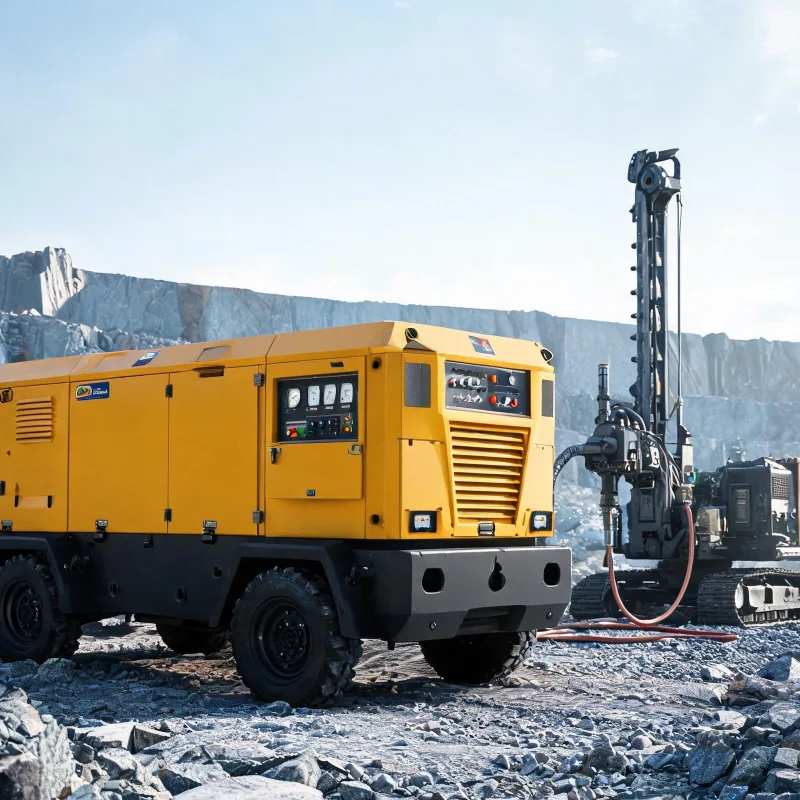
Training Learning Objectives
- Identify matching compressor specs for oilfield vs quarry pneumatic drilling
- Adjust output pressure to match drill bit load requirements
- Catch early failure signals before they cause unplanned downtime
Most on-site drilling crews don’t connect compressor output directly to drilling speed and bit wear.
These solutions apply to all tracked pneumatic drilling rigs between 5000 ft and 15000 ft depth for oilfields, and 20 ft to 300 ft depth for quarry blasting prep.
These solutions do not apply to small-scale manual drilling projects requiring less than 100 PSI of continuous output. Low-demand operations can use smaller portable units that don’t need the same sizing protocols.
Key Field Operational Commands
Size Compressor by Free Air Delivery (FAD), not working pressure alone
Working pressure is the minimum required for your drill. Free air delivery is the volume of air the compressor can supply continuously. For a 6-inch pneumatic drill bit, you need a minimum of 500 CFM FAD at 250 PSI working pressure.
The drill kept stalling under load, and no one caught the mistake for half a shift.
Set pressure drop allowance for long hose runs
Quarry operations often run 100+ foot hoses from the compressor to the drill. Oilfield operations may run hoses up to 200 feet for remote well pads. You have to add 10 PSI to your output pressure for every 50 feet of hose beyond the initial 50 feet.
A 150 foot hose needs a 20 PSI buffer above your drill’s minimum working pressure.
Live Demonstration Key Points
Oilfield Drilling Sizing Demo
We use a 250 PSI 800 CFM rotary screw compressor for a standard 8-inch oilfield pneumatic drill. The demo walks through matching FAD to drill air consumption, adjusting the pressure regulator, and checking for leaks in the line.
Quarry Drilling Sizing Demo
Quarry drilling uses lower average pressure but higher intermittent CFM demand for multiple drills running off one compressor. We demonstrate how to adjust load sharing settings when two drills are operating simultaneously.
Most crews run the compressor at full output even when only one drill is active. That wastes 15 to 20 gallons of fuel per 8-hour shift.
Common Misoperations to Avoid
Running the compressor at maximum pressure regardless of drill load increases wear on compressor valves and drives up fuel use unnecessarily. Only run at maximum pressure when the drill is at full depth under maximum load.
Contaminated air erodes the drill motor internal components from the first use. Drain the air tank daily before starting operations, no exceptions.
This lines up with what we see on our client sites across Texas and Alberta.
Change the filter every 200 operating hours, or 150 hours in high-dust quarry environments.
Proficiency Check Acceptance Criteria
Candidates will be given a drill spec sheet and a site conditions sheet that includes ambient temperature, hose length, and number of active drills. They must complete three core tasks: 1. Select the correct compressor FAD and working pressure from three options 2. Calculate the correct pressure buffer for the stated hose run length 3. List three non-negotiable daily maintenance checks to complete before startup
Passing score is 3 out of 3 correct responses. Any wrong response requires retraining before the crew member can operate the compressor unsupervised.
Implementation Checklist
- Pre-job: Calculate required FAD and pressure buffer for site conditions
- Pre-shift: Drain air tank, check inlet filter pressure drop
- Daily: Verify output pressure matches calculated requirement
- Weekly: Check compressor valve leakage and oil level
- 200 hour service: Replace inlet filter, change compressor oil
Glossary
- Free Air Delivery (FAD): Compressed air volume output adjusted for ambient conditions
- Working Pressure: Minimum constant pressure required to operate a pneumatic drill
- Pressure Drop: Pressure loss through air hoses and fittings over distance
- Load Sharing: Compressor function that adjusts output for multiple active drills
Maintenance Tips
- Replace inlet filters every 200 operating hours, 150 hours in high-dust quarries
- Change compressor oil every 500 operating hours per manufacturer specifications
- Drain moisture from the air tank after every shift to prevent internal rust
- Check valve seat wear every 1000 operating hours to avoid sustained output loss




