
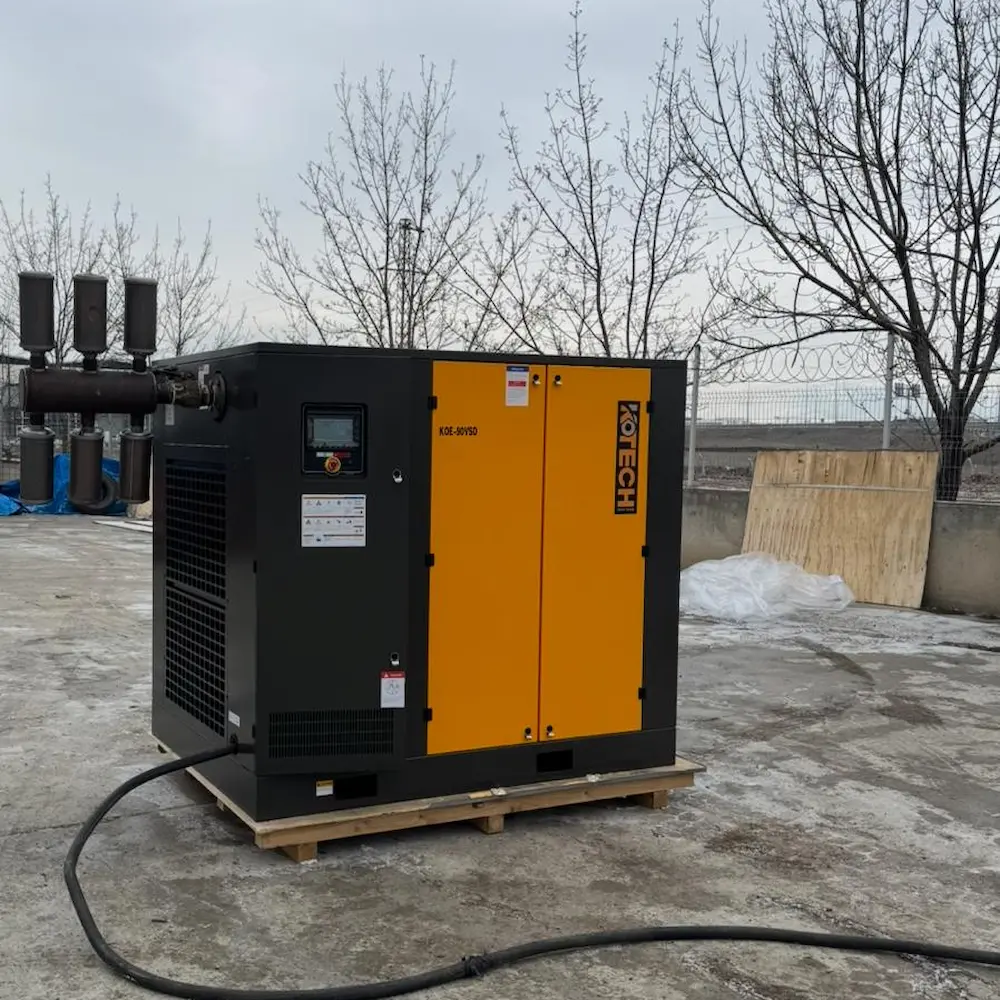
Kotech KOE-90 Stationary Compressor Delivers Reliable Instrument Air for Turkish Thermal Power Plants
The Kotech KOE-90VSD variable speed oil-injected screw compressor was deployed at a thermal power plant in Turkey's Muğla province to replace aging reciprocating compressors supplying instrument air for pneumatic controls, valves, and soot-blowing systems. Delivering up to 15.3 m³/min at 8.5 bar, the VSD technology matches motor speed to real-time demand, achieving 32% energy savings compared to fixed-speed units while maintaining ISO 8573 Class 1 air quality. Over six months of 24/7 operation, the compressor logged 99.5% uptime, reduced maintenance labour hours by 80%, and eliminated pressure fluctuations that had affected plant instrumentation. The case study demonstrates the KOE-90VSD's effectiveness for continuous instrument air duty in thermal power generation applications.
Get a QuoteCustomer Pain Points
Turkey's power generation sector relies on a mix of domestic lignite and imported natural gas, with coal-fired plants like the Yeniköy and Kemerköy facilities in the Gökova Bay region playing a critical role in the national grid. But keeping a thermal power plant running 24/7 isn't just about fuel and boilers—it's about keeping every auxiliary system operational, and compressed air is one of the most critical utilities on site.
A large thermal power plant in Turkey's Muğla province had been running a fleet of aging reciprocating compressors to supply instrument air across the facility. The plant's operations team had been dealing with three persistent problems that were eating into their reliability and maintenance budget.
Inconsistent air pressure was the first and most urgent issue. The reciprocating compressors would cycle on and off, causing pressure fluctuations that affected pneumatic control valves and actuators across the boiler house and turbine hall. The instrumentation team had documented several instances where pressure drops had caused control valves to respond sluggishly, affecting combustion control and emission readings. In thermal power plants, instrument air is used to operate pneumatic instruments connected with boilers, turbines, generators, precipitators, and ash handling systems—any pressure instability can cascade into process upsets . The operations supervisor put it this way: "When air pressure gets unstable, the instruments get nervous. And that makes us nervous."
Contamination was the second problem. The aging reciprocating compressors were showing signs of oil carryover, which risked contaminating the instrument air system. In a power plant, instrument air quality is of paramount importance and must mandatorily comply with ISO 8573 Class-1 standards to ensure pulsation-free discharge air for precise control of valve operations . Oil contamination in instrument air can foul solenoid valves and pneumatic positioners, leading to control system failures. The plant had recently failed a routine air quality test, and the maintenance manager was under pressure to fix it.
Maintenance costs were climbing. The reciprocating compressors required frequent overhauls—valve replacements, piston ring changes, and bearing servicing. The maintenance team was spending an increasing portion of their budget on compressor repairs. The plant's maintenance manager estimated that they were spending roughly 30% more on compressor maintenance than they had budgeted.
Energy waste was the fourth, emerging concern. The reciprocating units were fixed-speed, running at full capacity regardless of actual demand. During night shifts and low-load periods, the compressors would still run at 100% and then unload—a cycle that wasted a significant amount of electricity . The plant's energy manager had flagged compressed air as one of the largest auxiliary power consumers, and the operations team was under corporate pressure to reduce the plant's carbon footprint. "Every megawatt we save on auxiliaries is a megawatt we can sell to the grid," the plant manager noted.
Solutions
Kotech deployed the KOE-90VSD stationary variable speed drive oil-injected screw compressor—a unit combining the reliability of rotary screw technology with the energy efficiency of variable frequency drive, designed specifically for continuous industrial service in demanding environments like thermal power plants .
The KOE-90VSD is a 90 kW variable speed screw compressor delivering up to 15.3 m³/min at 8.5 bar, providing the volume and pressure needed for instrument air duties across a medium-sized thermal power plant . Unlike reciprocating compressors or fixed-speed rotary screw units, the VSD technology adjusts motor speed to match real-time air demand, eliminating energy waste during partial-load operation. The VSD motor ramps up smoothly during demand spikes, maintaining stable header pressure without the pressure fluctuations that had troubled the plant's instrumentation.
The variable speed drive was a key differentiator. Fixed-speed compressors run at 100% regardless of demand, wasting energy during unload cycles. The KOE-90VSD's VFD continuously adjusts motor speed to match air consumption, saving up to 35% energy in typical power plant applications . In a 24/7 operation like a thermal power plant, where night shifts and off-peak periods see significantly lower demand, the energy savings are substantial.
The oil-injected design was a deliberate choice. While oil-free compressors are often specified for instrument air, Kotech's oil-injected screw compressors with high-efficiency oil separation deliver air quality that meets or exceeds ISO 8573-1 Class 1 standards for instrument air applications . The oil-injected design also provides better sealing and cooling within the airend, extending component life and reducing maintenance frequency compared to reciprocating units.
The KOE-90VSD's enhanced cooling system was critical for the plant's location. Turkey's power plants experience significant seasonal temperature fluctuations, with summer temperatures in the region often exceeding 40°C . The KOE-90VSD features an oversized oil cooler and dual-circuit airflow management, maintaining stable operation even when turbine hall ambient temperatures reach 50°C . Specialized synthetic lubricants ensure viscosity retention at high operating temperatures.
The unit also features a modern touchscreen controller that integrates with the plant's control system, allowing remote monitoring of pressure, temperature, and filter status. The controller provides predictive maintenance alerts, enabling the plant's maintenance team to schedule service during planned outages rather than reacting to failures.
Implementation Steps
- System assessment. Kotech engineers conducted a thorough review of the plant's instrument air system, including demand profile, pressure requirements, and air quality standards. They also analysed the plant's existing piping network and compressor house layout to determine the optimal VSD configuration.
- Equipment configuration. The KOE-90VSD was configured with the plant's specific pressure setpoints and integrated with an air treatment package including filters and dryers to achieve the required air quality standards. The VSD parameters were tuned to the plant's demand profile.
- Installation. The unit was installed in the existing compressor house, with the stationary skid-mounted design allowing for straightforward placement on the prepared foundation. The 2-inch BSPT outlet connection was matched to the plant's existing header piping .
- Integration with plant DCS. The compressor's controller was integrated with the plant's DCS, allowing operators to monitor performance, energy consumption, and maintenance alerts from the central control room.
- Commissioning. The unit was run through a full operating cycle, with technicians verifying pressure stability, air quality, VSD response, and energy consumption. The plant's instrumentation team participated in the validation, confirming that air quality met ISO 8573 Class-1 standards.
- Operator training. Plant staff were trained on VSD operation, setpoint adjustment, filter changes, and routine maintenance procedures.
Customer results
Products Used in This Case

FAQ (Frequently Asked Questions)
Why is instrument air critical in a thermal power plant?
Instrument air is used to operate pneumatic instruments and control valves throughout the boiler house, turbine hall, and ash handling systems. The quality of instrument air is paramount because any contamination—oil, water, or particulates—can foul solenoid valves and pneumatic positioners, causing control system failures. Instrument air must meet ISO 8573 Class-1 standards for oil-free, dry, and clean air .
What's the difference between instrument air and service air in a power plant?
Instrument air is used for pneumatic controls and instrumentation, where air quality is critical. Service air is used for general cleaning, purging of filters, and ash transportation, where quality requirements are less stringent. In many plants, instrument air compressors are backed up by service air compressors through interconnection valves .
What's the advantage of a VSD compressor over a fixed-speed compressor in a power plant?
Power plants have variable compressed air demand. During peak operation, instrument air systems require high flow; during night shifts or low-load periods, demand drops significantly. Fixed-speed compressors run at full capacity regardless of demand, wasting energy during unload cycles. VSD compressors adjust motor speed to match real-time demand, saving up to 35% energy in typical power plant installations . The VSD also provides soft-start capability, reducing electrical and mechanical stress and extending equipment life.
What's the KOE-90VSD's capacity and pressure?
The KOE-90VSD delivers up to 15.3 m³/min at 8.5 bar, with the VSD system adjusting output across a wide speed range. The rated motor power is 90 kW, and the unit is designed for continuous operation in ambient temperatures up to 50°C .