
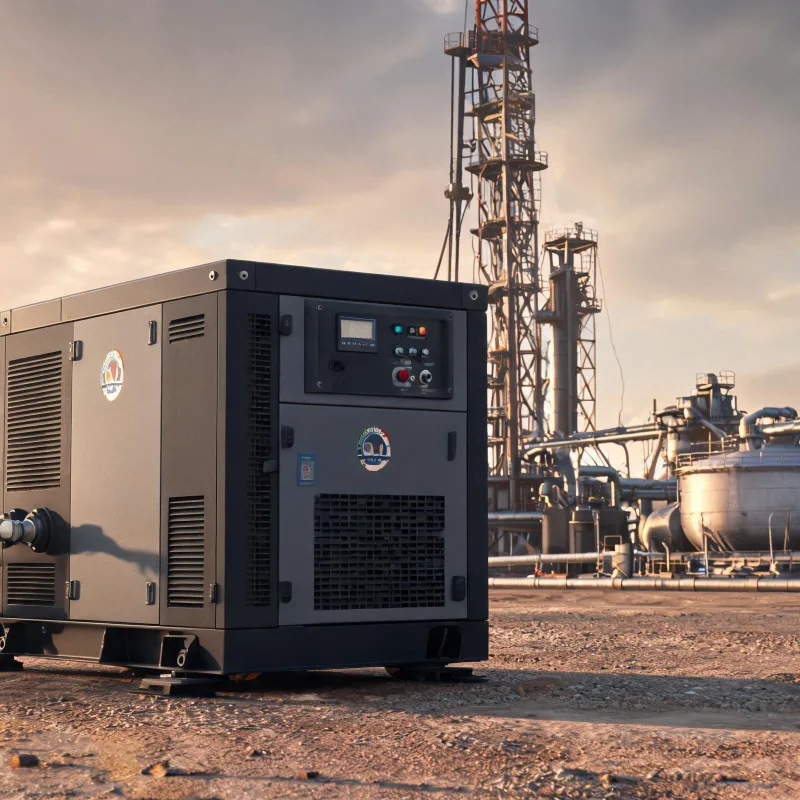
- General-purpose reciprocating compressors are not suitable for continuous offshore oil and gas operations
Compressed air systems are a non-negotiable utility across every segment of the oil and gas value chain. Most operational failures stem from incorrect equipment selection, not poor maintenance.
Core Use Cases Across the Value Chain
Upstream Exploration & Production
Compressed air powers instrument air systems that control drill actuators and emergency shutdown valves on onshore and offshore rigs. It also feeds nitrogen generation systems for well stimulation and pipeline purging after maintenance.
Midstream Processing & Transportation
In natural gas processing plants, compressed air acts as the control medium for pressure regulation valves and separation equipment. It also supplies breathing air for personnel entering confined or toxic storage spaces.
Downstream Refining
Refineries use compressed air for process actuation, soot blowing for heat exchanger maintenance, and pneumatic conveying of catalyst materials. Oil-free systems are required here to avoid contaminating end products like gasoline or diesel.
Verified Industry Data & 2024 Trends
Offshore operations have far stricter requirements for corrosion resistance and continuous operation.
The growth is driven by fleet upgrades to meet new energy efficiency standards launched in 2023 by the EPA.
This makes compressed air systems one of the top 5 causes of midstream production loss.
Boundary Conditions & Unsuitable Use Cases
Not all industrial compressed air equipment works for oil and gas applications. Low-cost reciprocating compressors designed for general construction use are not suitable for continuous 24/7 offshore operation. Constant vibration, salt corrosion, and high demand will cause these units to fail within 18-24 months, 3x faster than purpose-built units.
Even oil-flooded rotary screw compressors are unsuitable for instrument air and process applications in refining. API Class 0 oil-free certification is required to avoid product contamination and safety hazards.
Actionable Best Practices
For offshore applications, specify corrosion-resistant coated internals and IP67-rated electrical components to extend service life.
Schedule quarterly leak inspections. This directly increases energy costs and reduces system pressure for critical safety operations.
Implementation Checklist
Use Cases
- Upstream: Well drilling, emergency shutdown, nitrogen generation for well workover
- Midstream: Natural gas processing, valve actuation, personnel breathing air
- Downstream: Refining process control, catalyst conveying, soot blowing for heat exchangers
- Offshore: All safety-critical control systems, utility air for maintenance
Buyer Guide
1. Confirm if your application requires API Class 0 oil-free certification 2. For offshore use, specify corrosion-resistant internals and IP67 electrical components 4. Match compressor type to operation profile (continuous vs intermittent use)
Pitfalls to Avoid
- Don’t use general-purpose reciprocating compressors for 24/7 offshore operation
- Don’t skip installing a high-quality air dryer to cut upfront costs
- Don’t use oil-flooded compressors for instrument air applications




