
- They are most widely deployed for exploration drilling, pneumatic tools, and emergency mine ventilation
- They are not suitable for fixed deep underground operations requiring constant high-volume air flow
Portable diesel air compressors fill critical power gaps for temporary and remote mining sites. They deliver reliable compressed air without grid access for three core use cases below.
Exploration and Blast Drilling
Small-scale surface and grassroot mineral exploration projects almost always operate in remote, off-grid locations. Crews move drill sites every few days, so permanent compressed air infrastructure doesn’t make financial sense.
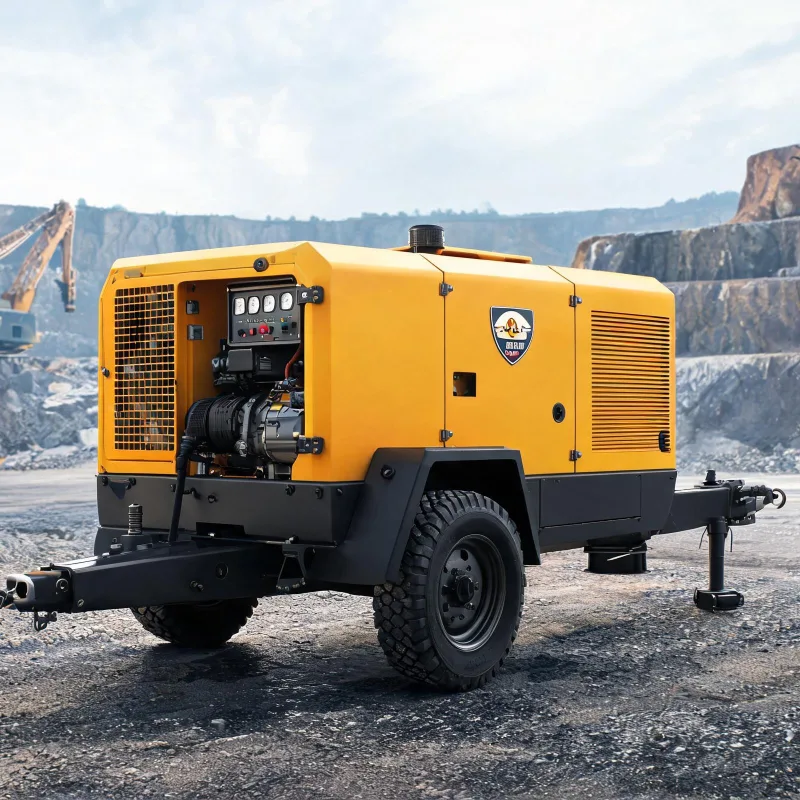
Setup takes less than two hours, compared to two full days for permanent plumbed systems.
Most portable units fit on a standard pickup truck bed or small trailer, so crews don’t need special heavy haul permits to move between sites.
Powering Pneumatic Mining Tools
Pneumatic hand tools like jackhammers, rock bolters, and scaling bars are standard for temporary and hazardous mining work zones. Unlike electric tools, they don’t carry arc flash risk in wet or dusty explosive environments.
All of these require a reliable on-source of compressed air to operate.
Portable diesel units deliver consistent 90-150 psi pressure, which matches the requirement for nearly all standard handheld mining pneumatic tools. A 185 cfm unit can run one to two tools at the same time, enough for most small maintenance or development crews.
Portable units only add value for mobile or short-term work.
Emergency and Auxiliary Ventilation
Underground mines need backup ventilation when main shaft fans fail, or when crews work on new development headings not yet connected to the main ventilation duct network.
Most small mines don’t have a second fixed backup fan, so portable units fill this gap.
A 750 cfm portable diesel compressor can connect to temporary ventilation ducting to push fresh air into a 500-meter development heading within 30 minutes of an outage. This gives crews enough time to make repairs or evacuate safely.
It’s a low-cost investment that avoids major fines and saves lives.
Use Case Limitations
Portable diesel air compressors don’t work for all mining applications.
They don’t deliver enough continuous air volume for primary ventilation in large underground mines. They also produce exhaust emissions, so they can’t be run for extended periods in enclosed underground spaces without proper exhaust ducting.
For fixed production zones that need compressed air 24/7, stationary electric compressors are far more cost-effective and compliant with long-term safety rules.
Actionable Best Practices
Match your compressor size to your maximum expected air demand: 185 cfm for handheld tools, 375-750 cfm for exploration drilling, 750+ cfm for emergency ventilation.
Always buy a unit certified by MSHA for use in hazardous mining environments. Uncertified units can fail safety audits and create explosion risks from unmanaged sparks.
Test your unit as part of monthly emergency drills to make sure it starts and runs when you need it. Don’t wait for an outage to discover a dead battery or clogged fuel filter.
Common Myths
- Myth: Portable diesel compressors can replace fixed units for all mining applications. Fact: They only work for temporary or emergency use cases.
- Myth: Any portable compressor is safe for mining. Fact: You need MSHA-certified units for hazardous underground areas.
Use Cases
- Remote small-scale surface mineral exploration
- Temporary underground mine development headings
- Emergency backup for mine ventilation systems
- Mobile pneumatic tool operation in work zones
- Pre-production blast hole drilling
Buyer Guide
- 185 cfm: For 1-2 handheld pneumatic mining tools
- 375-750 cfm: For small to medium exploration drilling
- 750+ cfm: For auxiliary emergency mine ventilation
- Prioritize MSHA-certified units for all mining use




