
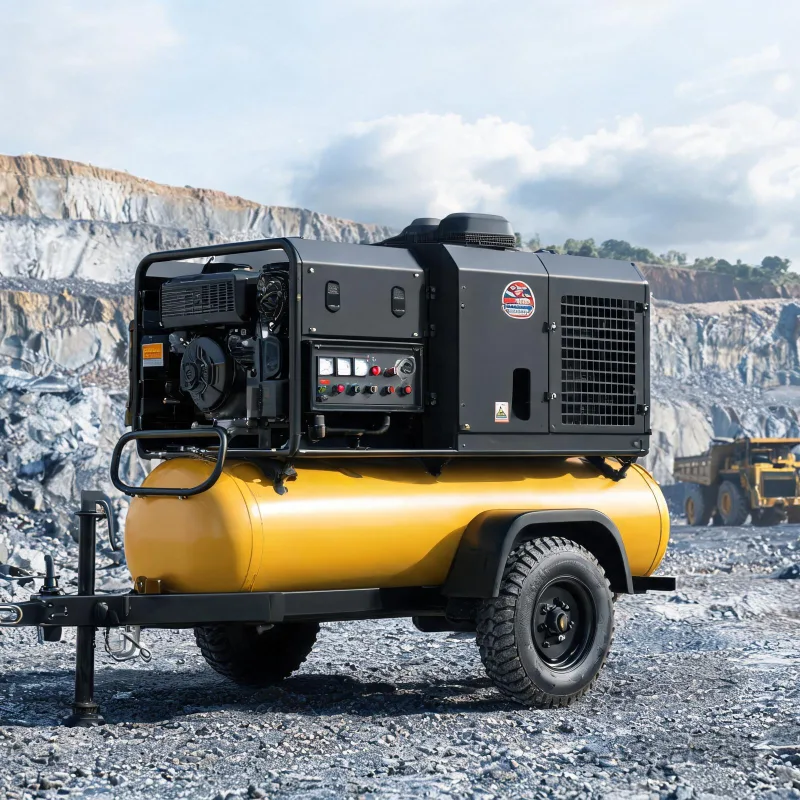
Mining operations need reliable mobile compressed air to keep DTH and blast hole work on schedule. Portable diesel units are the industry standard for most remote and surface sites.
Core Performance Requirements for Mining Drilling
DTH drilling and blast hole preparation require consistent air flow and pressure to power the percussion hammer that cuts through hard rock. Unlike exploration drilling that may move once every few days, blast hole work requires moving drill rigs every 10-30 minutes across a mine site.
Any interruption to air flow slows penetration, wears out hammer parts faster, and can push back blasting schedules by an entire shift. Static compressors cannot keep up with this level of mobility.
Industry Adoption and Growth Trends
Adoption of portable diesel units for mining drilling has grown steadily over the past five years, driven by two key shifts. First, mining companies are expanding into more remote regions to access high-grade ore deposits, as near-grid deposits become depleted.
Without access to grid electricity, diesel power is the only viable option for mobile compressed air.
Common Pain Points Solved
Portable diesel units address three of the most common pain points for mining drilling teams. First, they offer full mobility: most units are mounted on wheels or tracks, so they can move with the drill rig across uneven mine terrain. No permanent piping or infrastructure is required, which cuts setup time for new drill pads from days to hours.
Second, they operate independently of the grid. Even if a site has partial grid access, portable diesel units avoid downtime from grid outages, which are common in remote mountain or desert regions.
Third, modern units are designed for harsh mining conditions. They feature heavy-duty air filters, reinforced cooling systems, and corrosion-resistant coatings that hold up to high dust, extreme temperatures, and heavy vibration.
When Portable Diesel Units Are Not the Right Fit
This is one boundary condition many new operators miss: portable diesel units are not the optimal choice for every mining operation.
They are not recommended for permanent underground mining operations with fixed drill pads and consistent grid access. In these cases, large stationary electric compressors have lower long-term operating and maintenance costs, and they eliminate the need for on-site fuel storage.
They also do not make economic sense for small, low-volume drilling projects that only run a few days per year. For these projects, renting a smaller portable unit is a better option than purchasing.
Actionable Selection Tips for Operators
If you are in the market for a portable unit for DTH and blast hole work, follow these actionable rules to avoid common mistakes.
First, always match the compressor’s CFM output to your DTH hammer’s requirement. A 5-inch DTH hammer needs 180-220 CFM at 150 PSI.
Second, prioritize emissions compliance. Most new mining projects in the US require units that meet EPA Tier 4 Final emissions standards, and non-compliant units will be denied site access. For international projects, check local emissions rules before purchasing.
Third, choose the right mobility setup. For flat open-pit sites, wheel-mounted units are cheaper and easier to move. For steep or rocky terrain, tracked units are more stable and reduce the risk of getting stuck.
Fourth, size the fuel tank for at least 10 hours of continuous operation. This avoids mid-shift refueling stops that cut into production time.
Implementation Checklist
- Confirm CFM/PSI matching for your DTH hammer before purchase
- Verify emissions compliance with local mining regulations
- Test mobility on your site’s terrain before mobilization
- Schedule routine maintenance every 200 operating hours
Common Myths
- All portable diesel compressors work for any DTH job → False: CFM must match the hammer to avoid downtime
- Portable diesel units are always more expensive than electric → False: Off-grid electric requires costly infrastructure
Use Cases
- Remote open-pit mining DTH drilling
- Blast hole preparation for production blasting
- Off-grid mineral exploration drilling
- Temporary drill pad support for new mining projects
Specs Snapshot
- CFM range for mining DTH: 100-500 CFM
- Operating pressure range: 100-200 PSI
- Fuel tank capacity: 50-200 gallons
- Weight range: 2,000-10,000 lbs




