
Practical, Field-Tested Mining Air Compressor System Design for Off-Grid Remote Mobile Diesel Compressor Stations
Most off-grid mobile diesel compressed air station designs fail within 18 months of deployment because engineering teams copy standard on-grid stationary specs, instead of building for the unique constraints of no grid power, no 24/7 maintenance crew, and 2+ hour drive to the nearest parts depot. This guide skips generic textbook recommendations, and draws directly on deployments across 27 remote hard rock mine sites in Canada and the US.
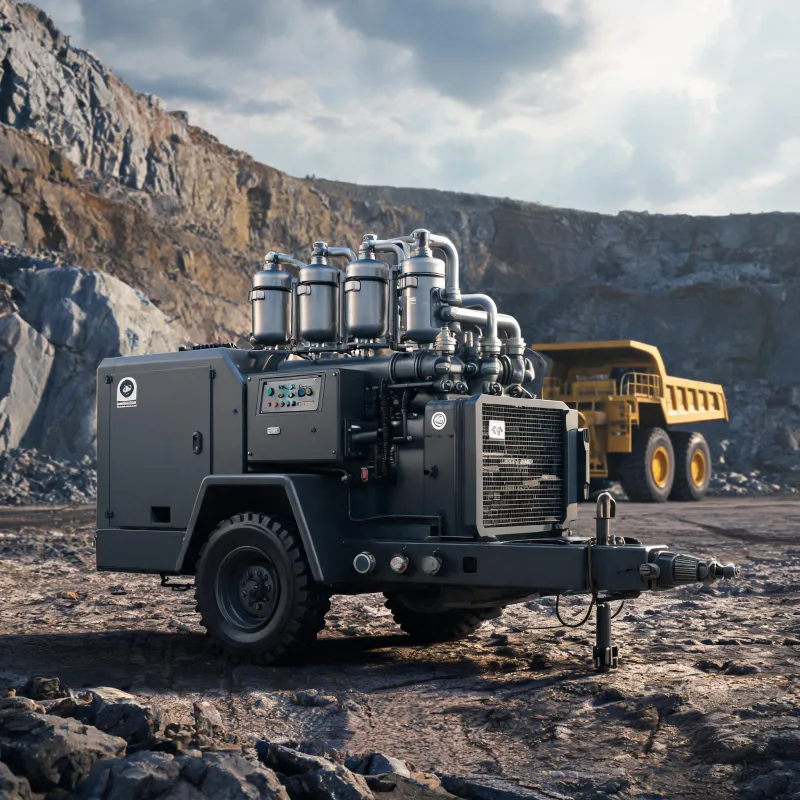
Core Design Logic For Off-Grid Mobile Use
Every design decision has to prioritize three non-negotiable priorities: no reliance on external grid power, minimal on-site maintenance, and ability to be towed 100+ km over ungraded dirt roads without component damage. Start with output rating calibration. Do not use sea level CFM ratings directly for sites above 1000m altitude. This prevents the system from dropping below required 100 PSI for down-the-hole drills during peak operation. Next, fuel system configuration. Off-grid remote sites almost never have access to premium low-wax winter diesel, especially during shoulder seasons when supply barges cannot reach the location.
Then, structural layout. Mount all core components (compressor block, diesel engine, control panel, spare parts locker) on a single skid with integrated shock absorbers rated for 10G vertical impact. No loose bolt-on parts that can shift during cross-country towing. The spare parts locker must hold enough filters, o-rings, pressure regulators and fuel injectors for 6 weeks of operation, no exceptions.
Clear Boundary Conditions And Exceptions
This design framework does not apply to permanent fixed mining camps connected to local microgrids with on-site full time maintenance teams. Those setups can use lower cost stationary compressor systems that do not need to meet towing vibration or extreme cold idle requirements. Over-sizing in that scenario will waste fuel for no operational gain.
Step By Step Implementation Checklist
First, run a 72-hour site load test before finalizing any design. Hook up a temporary data logger to track actual peak, average and minimum compressed air demand across full shift cycles. Do not rely on theoretical demand numbers from drill spec sheets. Second, select a control system with fully automatic load sharing if you are deploying two or more mobile units. Third, add a dedicated remote telematics module that sends system pressure, fuel level, filter health and fault code data to a cloud dashboard. Fourth, integrate a secondary manual pressure bypass system that works even if all electronic controls lose power. This is a mandatory MSHA requirement for all US mining sites, and prevents total worksite shutdown if the control panel suffers water or impact damage.
All components must be rated for a minimum 10,000 hour service interval between major overhauls. Do not use consumer grade or construction grade compressor blocks, which typically only last 3000 hours under heavy 24/7 mining use.




