
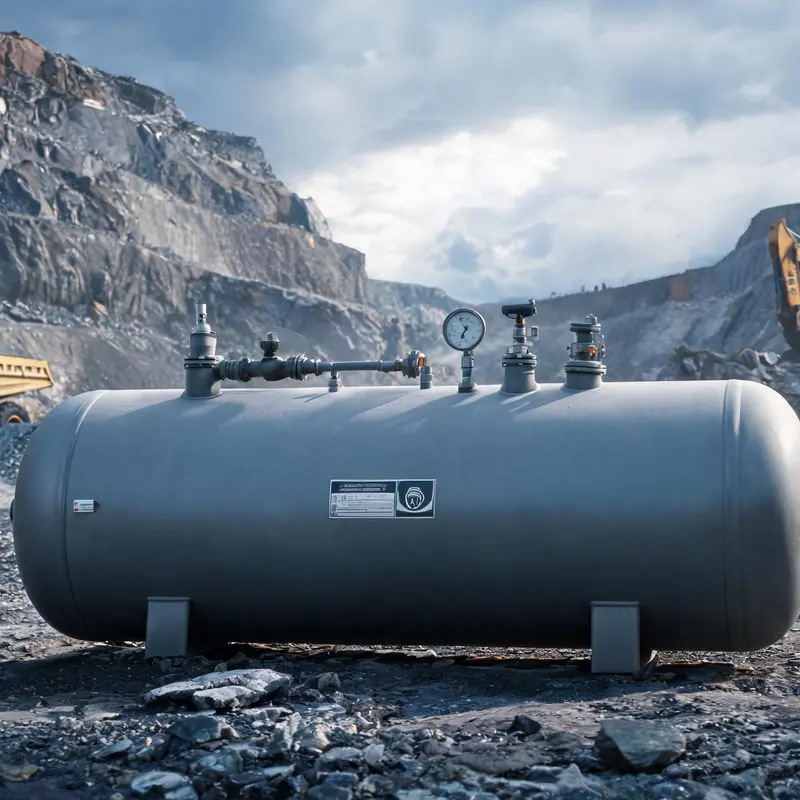
air receiver tank sizing for mining compressed air systems
Why receiver sizing matters in mining compressed air systems
An air receiver is stored energy between the compressor and the load. In mining, demand is rarely steady. Drills, loaders, pumps, stoppings, fans, blowers and maintenance tools can start at different times, often through long piping runs. A receiver that is too small allows pressure to fall quickly, forces the compressor to chase load, and can cause short cycling or frequent loading and unloading.
A properly sized tank does not increase compressor capacity, but it makes the existing capacity more useful. It absorbs short peaks, allows the compressor to run in stable control bands, reduces rapid pressure changes, and gives moisture more residence time so downstream separation and drying equipment can work effectively. Storage also protects production when a compressor is starting, switching over, or recovering after a power interruption.
Oversizing is not automatically better. A very large tank can take longer to pressurise, increase installation and lifting requirements, occupy more skid or underground space, and may allow compressors to remain unloaded too long if controls are poorly matched. The objective is enough useful storage for the expected demand pattern without creating control problems.
Receiver sizing should therefore be treated as part of total system design: compressor output, pressure rating, control method, dryer capacity, pipe network, leakage, altitude and location of major loads all affect the result. A tank selected by a simple rule alone may work on paper but still fail at the working face.
Start with air demand, duty cycle and load profile
The first sizing input is not tank volume; it is the air demand profile. List every major user, its flow requirement, operating pressure, frequency and duration. Separate continuous loads from intermittent or pulse loads. Continuous loads are better supplied directly by compressor capacity, while short peaks are often supplied efficiently from storage.
For mining systems, record typical production cycles rather than only nameplate totals. A drill may consume air steadily, but mucking, blasting support, pumping, track maintenance, cleaning and bulk material handling can create simultaneous peaks. Note whether loads are near the compressor room or at the end of long headers, because remote pressure loss can make a correctly sized surface tank appear inadequate.
Use this information to identify the largest short-duration demand event that storage must cover. That event can be expressed in cubic feet or cubic metres of air, or as an excess flow over compressor output for a defined number of seconds or minutes. Average demand helps select compressor capacity; peak event size helps select storage.
Also include leakage and artificial demand. Leaks create continuous loss, while pressure above what tools require increases consumption at unregulated endpoints. Repairing leaks and setting correct pressure at the point of use can reduce the storage needed. If demand data is incomplete, use temporary flow and pressure logging during normal production and maintenance periods before finalising tank size.
How to estimate required receiver volume
A common storage calculation uses the relationship among receiver volume, allowed pressure change and the amount of air that must be delivered during an event. In US customary units, a useful form is: receiver gallons approximately equal to cubic feet of air required during the event times 14.7 divided by allowed pressure drop in psi, with gauge pressure converted to absolute pressure. In metric units, work with absolute pressure in bar and receiver volume in cubic metres or litres.
A simplified practical method is:
- Find the event flow that exceeds available compressor output.
- Multiply excess flow by event duration to obtain required stored air.
- Choose the acceptable pressure drop between the normal compressor cut-in or load point and the lowest acceptable pressure at the receiver.
- Convert that pressure swing to absolute pressure and calculate receiver volume.
- Add a safety margin for leakage, response delay, altitude and future loads.
For example, a compressor control band of several bar or tens of psi provides more usable storage than a very narrow band. Widening the band can reduce tank size, but only if all downstream tools, dryers, filters and regulators can tolerate the lower pressure. The relevant pressure is at the point of use, not merely at the compressor outlet.
Rules of thumb can be used for early layout, but they should not replace the event calculation. Typical simple recommendations relate gallons to compressor CFM or litres to compressor m³/min, yet these do not account for unusually large pulse loads, long remote headers, multiple compressors or high leakage. Use them only as a sanity check.
Wet receivers, dry receivers and tank location
Mining systems may use wet receivers, dry receivers, or both. A wet receiver is installed before drying equipment, immediately after the compressor and aftercooler. It helps smooth compressor loading, provides primary moisture separation, and supports load/unload or modulation control. It is especially useful when compressors start and stop against variable production demand.
A dry receiver is located after drying and filtration, often closer to a remote header or intermittent load. It delivers clean, dry air during sudden demand and reduces the effect of pressure loss in long piping. Dry storage is valuable for underground faces, skid-mounted process equipment, batch tools, and loads that require rapid response without waiting for air to travel from a central compressor room.
Location changes effective storage. A large tank at the surface does not fully protect an underground tool if the connecting pipe is too small, restricted, or lined with filters and hoses causing pressure loss. In that case, local dry storage near the load may be more effective than increasing the central tank. Conversely, multiple small tanks scattered without drainage or pressure control can create maintenance burden and corrosion risk.
A balanced design often uses a wet receiver sized for compressor control and moisture separation, plus targeted dry storage for the largest intermittent users. Pipe size, check valves, isolation valves, drain access, pressure relief protection and condensate removal must be designed with each tank location.
Compressor controls, pressure band and number of machines
Receiver size and compressor control strategy must be selected together. A compressor with load/unload control needs enough storage to avoid rapid cycling when demand is below full output. If the tank is too small, pressure rises and falls quickly, causing frequent motor loading, unloading and possible starts. A larger receiver or a wider pressure band gives the controller time to react.
Variable-speed compressors can match moderate demand changes more closely, but they still benefit from storage during abrupt loads. Storage prevents a sudden drop while the drive ramps up and reduces the need to operate at minimum speed with unstable pressure. In multi-compressor stations, receivers help sequence machines and prevent several units from reacting simultaneously to one short event.
Set the pressure band around actual process requirements. The highest pressure should satisfy the most remote critical tool after piping and treatment losses; the lowest pressure should still allow reliable operation. A narrow band improves pressure consistency but needs more storage. A wider band reduces required tank volume but may increase unregulated air consumption and stress on equipment rated for a limited pressure range.
When multiple compressors share a header, coordinate their setpoints so one machine trims demand while base units run efficiently. Receiver sizing should consider the trim compressor’s turndown, the largest single load step, and the time required for a standby compressor to start and deliver air. If standby start time is long, storage must bridge that interval.
Site factors that can change the calculation
Several mining-specific conditions reduce the usable value of calculated storage. Altitude lowers air density, so a compressor rated at sea level produces less mass flow at elevation. The tank still holds the same geometric volume, but the system’s available delivered air changes. Sizing should use site-adjusted compressor performance rather than catalogue flow at standard conditions.
High ambient temperature also affects moisture load and effective air density. Hot air entering receivers carries more water, and inadequate aftercooling increases condensate burden. If the wet receiver is expected to aid separation, residence time and drain reliability become part of the sizing decision. Cold locations can create freeze risk in drains, valves and remote piping, so tank placement and heat tracing may be necessary.
Pipe and hose restrictions are commonly overlooked. Storage cannot respond instantly if flow must pass through narrow lines, blocked filters, undersized quick couplings or many fittings. Check total pressure differential from receiver to critical tool during peak flow. If differential is excessive, increasing tank size alone will not correct the problem.
Finally, allow for growth and deterioration. New mining panels, additional tools, longer headers, compressor wear and leakage all increase demand over time. A reasonable design margin is useful, but it should be deliberate rather than an oversized tank used to conceal avoidable losses. Review storage whenever major equipment is added, production cycles change, or pressure complaints become frequent.
Practical receiver sizing checklist for buyers and engineers
Use the following sequence before approving a receiver tank for a mining compressed air system:
- Define minimum acceptable pressure at each critical point of use.
- List continuous, intermittent and simultaneous air demands.
- Identify the largest short-duration event and its duration in seconds or minutes.
- Confirm site-adjusted compressor flow at altitude and expected ambient temperature.
- Select a pressure band that equipment and tools can tolerate.
- Calculate required usable storage from excess flow and allowed pressure drop.
- Decide whether wet storage, dry storage, or both are needed.
- Check header and hose size from tank to remote loads.
- Include drains, pressure relief, isolation, inspection access and corrosion protection.
- Leave a defined margin for leakage, future tools and production expansion.
Before purchase, verify the tank pressure rating matches the highest normal operating pressure and any expected upset condition. Confirm local code requirements for vessel certification, relief valves, mounting, transport and inspection. Mining environments may also require robust coatings, skid protection, drainage and clearance for removal or servicing.
If calculations show an unusually large tank, investigate the cause before simply buying more volume. The issue may be an unnecessarily narrow pressure band, undersized pipe, excessive leakage, a compressor with poor turndown, or a remote load that needs local dry storage. Correcting those issues often gives better pressure stability at lower installed cost.
The final design should be documented with expected pressure at the compressor, receiver and critical work areas. After commissioning, log pressure and compressor cycling during normal peaks. Frequent cycling, rapid receiver pressure decay, or low pressure at the face despite adequate compressor load indicates that storage or distribution should be reviewed.
Implementation Checklist
- Record minimum required pressure at each critical point of use.
- Log normal and peak demand during production and maintenance cycles.
- Calculate usable storage from excess flow, event duration and pressure swing.
- Confirm wet and dry receiver locations with the dryer and piping layout.
- Review compressor sequencing and standby start time.
- Inspect drains, relief valves, isolation valves and corrosion protection.
- Reassess storage after adding equipment or extending the air network.
Buyer Guide
- Define the largest short-duration demand event before selecting tank volume.
- Verify site-adjusted compressor flow at mining altitude and ambient temperature.
- Check vessel pressure rating, certification, relief protection, drain access and coating requirements.
- Compare central wet storage with local dry storage for remote underground or skid-mounted loads.
- Confirm physical clearance for transport, installation, inspection and condensate removal.
Pitfalls to Avoid
- Using a generic CFM-to-gallon rule without evaluating peak events.
- Ignoring pressure loss through long headers, hoses, filters and couplings.
- Setting the pressure band too narrow and then oversizing the tank.
- Treating a receiver as a substitute for compressor capacity or leak repair.
- Placing all storage at the surface when the critical load is remote.




