
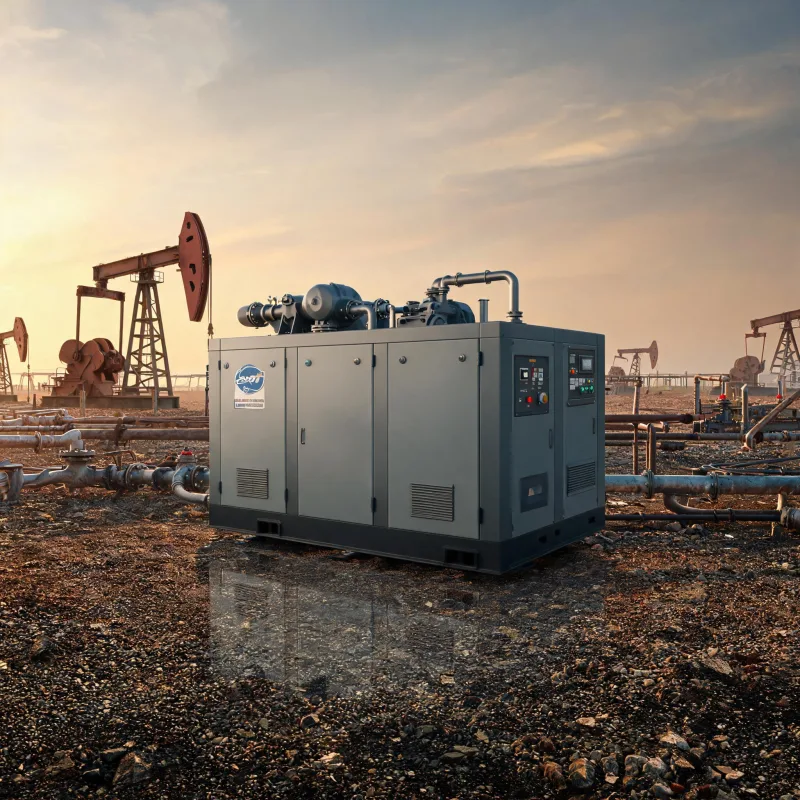
Core Requirements and Common Use Cases for Oil & Gas Air Compressors
Not all industrial air compressors work for oil and gas operations. Selecting the right unit depends on compliance, environment, and specific use case. Wrong choices lead to exponentially higher operational costs.
Core Performance & Compliance Requirements
Explosion Protection Mandates
All operations in Class I, Division 1 hazardous areas require explosion-proof (ATEX or NEC 500 compliant) units. Vapor leaks from oil or natural gas can ignite from a spark in a non-compliant motor.
It’s not worth the short-term cost savings.
Environmental Hardening Requirements
Oil and gas sites expose compressors to extreme conditions: dust, salt spray, wide temperature swings, and high altitude. Units must have sealed enclosures, corrosion-resistant coatings, and oversized cooling systems.
Most operators forget to adjust sizing for this factor upfront.
This requirement does not apply to temporary pop-up exploration sites that operate for less than 30 days in low-risk zones.
Verified Industry Trends & Data
The growth is driven by expanded EOR (enhanced oil recovery) projects that require consistent high-pressure injection.
The shift comes from stricter regulations around product contamination of natural gas streams.
Common Use Cases
Onshore Well Drilling & Well Control
Drilling operations use compressed air to power downhole tools, circulate drilling mud, and control well pressure. Requirements include high CFM output, portable skid-mounted designs for remote sites, and explosion-proof certification.
Enhanced Oil Recovery (EOR) Injection
EOR projects use compressed air to pressurize mature reservoirs and push remaining crude oil to production wells. This application requires large fixed units with consistent high pressure output, 24/7 continuous operation capability.
Natural Gas Processing & Transmission
Compressed air powers valves, actuators, and processing equipment in natural gas plants. Oil-free compressors are required here to prevent contamination of the processed gas stream that would damage end-use equipment.
Offshore Platform Operations
Space is limited on offshore platforms, so compressors need compact, corrosion-resistant designs that can withstand constant salt spray exposure. Units must also meet strict marine safety standards for vibration and fire resistance.
Practical Selection Tips for Operators
First, calculate your required CFM adjusted for your site’s elevation and maximum ambient temperature. Nameplate ratings are measured at sea level and 70°F, so they do not reflect real-world output in most oil and gas sites.
Second, confirm compliance with local hazardous area classification before you purchase. Do not rely on the seller’s general claim of “industrial grade” — ask for specific ATEX or NEC certification documentation.
Third, match the unit type to your operation timeline. Permanent sites benefit from larger fixed screw compressors, while temporary exploration operations should use rented portable reciprocating units.
Common Myths
- Myth: Any industrial air compressor works for oil and gas operations
- Fact: Non-certified units carry major safety and compliance risks
- Myth: Nameplate CFM ratings apply to all site conditions
Use Cases
- Onshore well drilling and well control
- Enhanced oil recovery (EOR) air injection
- Natural gas processing and transmission
- Offshore platform utilities and actuation
- Pipeline maintenance and testing
Specs Snapshot
- Required compliance: ATEX / NEC 500 for Class I Div 1 areas
- Minimum IP rating: IP66 for offshore / dusty onshore sites
Cost Factors
- Maintenance cost: Portable temporary units have 2x higher annual maintenance cost




