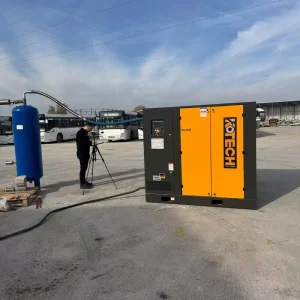
petroleum compressed air packages
Selecting a Petroleum Air Package for an Unmanned Well Pad With Intermittent Loads
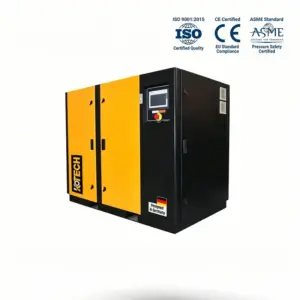
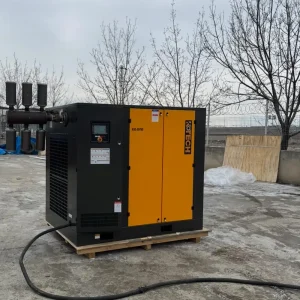
When a well pad needs compressed air for valve actuation, instrument loops, purge connections, and occasional utility duty, use a skid-mounted rotary screw package. It should include an integrated receiver, dryer, filtration, and local controls. Base pressure is commonly 7–10 bar (100–145 psi), but the package should be selected from the minimum pressure needed at the farthest user, plus line and treatment losses. At intermittent sites, storage and stable control are usually better choices than oversized compression.
Calculate demand by listing simultaneous users, not every connected device. Instrument air consumption can be low during steady operation, but it increases during valve sequencing, blowdown events, and maintenance use. Size a receiver to cover short peaks. This lets the compressor run in efficient loaded cycles and reduces rapid cycling. A typical check compares stored useful air—receiver volume multiplied by the allowed pressure change and corrected to actual conditions—against the largest short-duration demand.
Recommended setup:
- Rotary screw compressor with load/no-load or modulated control suited to the site duty cycle.
- Wet air receiver before drying when slugs or high ambient humidity are expected.
- Refrigerant or desiccant dryer selected for the lowest ambient and required pressure dew point.
- Coalescing and particulate filtration, with isolation valves and differential indication.
- Weather-protected, ventilated skid with emergency stop, high-temperature shutdown, and drain management.
If the pad is electrically classified, the motor, starter, instruments, lighting, and ventilation must suit the zone or division, gas group, and temperature class. Do not accept a standard industrial skid simply because it is outdoors. Verify drain discharge routing, grounding, clearance for cooler cleaning, and access for filter changes. A common trade-off is a larger receiver versus a larger compressor. Storage usually handles brief peaks more effectively, while compressor capacity is needed when demand is sustained.
Package Configuration for Offshore or Coastal Modules With Limited Space and Corrosive Air
For a platform, FPSO module, coastal terminal, or another salt-laden site, choose a compact, corrosion-resistant instrument and utility air package. Maintenance access and lifting opportunities are constrained, so these packages should prioritize accessible layout, reliable cooling, treated air quality, and redundancy. A duty/standby compressor arrangement with dedicated or shared drying is often preferable to one large machine, especially when instrument air supports shutdown systems.
Maximum flow is not always the limiting condition. Check the package against available footprint, lifting weight, door swing, cooler removal path, ventilation route, and emergency egress. Air-cooled machines need enough ambient airflow and can struggle in hot, recirculating spaces. Water-cooled machines reduce ventilation load, but they need a reliable cooling-water circuit and leak management. Specify marine-grade coating systems, stainless or corrosion-resistant fasteners, protected instrumentation, and sealed cable entries suited to the coastal environment.
Recommended setup:
- Multiple smaller compressors arranged for duty/standby or lead/lag operation.
- Heatless or externally heated desiccant drying when a low pressure dew point is needed; refrigerant drying only when temperature and air-quality requirements allow it.
- Duplex or monitored filtration with bypass-free isolation for critical instrument air.
- Vessel certification, lifting points, and structural base suitable for the location’s inspection regime.
- Condensate collection that prevents oily water discharge into untreated deck drains.
Check air treatment at the worst operating case: high humidity, high inlet temperature, low cooling-medium temperature, and maximum simultaneous demand. A dryer rated at one condition may be undersized when compressed air enters hotter than expected. Compare redundancy philosophies as well. A standby compressor protects production if one machine fails, but a single dryer can remain the weak point unless it is monitored, safely bypassed, or duplicated. Every package should have clear pressure, dew-point, filter, and shutdown annunciation so operators can detect degradation before instrument loops are affected.
Air Packages for Loading Racks, Tank Farms and Other Hazardous Hydrocarbon Zones
Use an electrically classified, positively ventilated, or remotely located compressed air package when air users are near hydrocarbon loading, tank vents, pigging operations, or possible vapor release. The first engineering decision is whether the compressor skid can be installed outside the classified area. Putting a standard utility package in a safe area and routing air headers to users is often simpler and less costly than placing every component in a rated enclosure.
When the package must be inside or next to a hazardous area, select components based on the actual classification: zone or division, gas group, temperature class, and extent of the classified boundary. Electrical items are not the only concern. Include ventilation timing, gas detection interlocks, spark-arresting considerations where applicable, static grounding, hot-surface limits, and surface temperature controls. A pressurized enclosure can protect normal-service electrical equipment, but it requires purge air, door interlocks, loss-of-pressure alarms, and a documented startup sequence.
Recommended setup:
- Classified-area compressor and controls, or a safe-area installation with buried or routed air supply.
- Positive-pressure ventilation with purge timing and shutdown on loss of ventilation or gas detection.
- Oil-flooded screw compressor with high-efficiency coalescing filtration, or oil-free compression where the site standard prohibits oil carryover.
- Desiccant drying if instrument air is exposed to low ambient temperatures or requires a consistently low dew point.
- Automatic condensate drains routed to a closed collection system.
Inspect the air path as carefully as the electrical path. Instrument air entering transmitters, positioners, and emergency shutdown valves should be free of liquid water, particulate, and oil aerosol. A practical acceptance check is to monitor pressure dew point downstream of drying and verify a margin below the lowest expected pipe or enclosure temperature. Do not use flexible hoses, quick couplings, and temporary filters for permanent safety-related loads. The trade-off is capital cost versus operational risk. Safe-area placement may require more piping, while classified-area installation demands more protected equipment and stricter inspection.
Remote Pipeline or Production Stations With Weak Grid Power and Limited Maintenance Visits
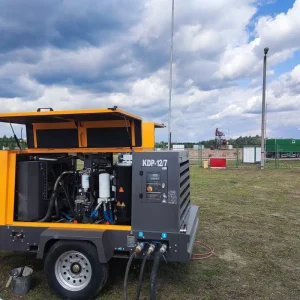
Select a fuel-flexible, continuously monitored petroleum compressed air package when the station is remote, exposed to temperature extremes, and visited on a schedule rather than daily. Electric drive is preferable where reliable power exists. Where grid power is weak or unavailable, engine-driven packages using site-approved diesel or suitable field gas may be necessary. The package should start reliably after cold soak, survive high ambient heat, and keep operating through short air demands without frequent attention.
Define the lowest acceptable operating pressure at the critical user. Then work backward through dryer loss, filter loss, regulator loss, and piping loss. A remote station should not be sized so that a small transient causes shutdown. Provide enough receiver storage to ride through short compressor faults, valve movements, or control delays, but do not use storage as a substitute for reliable compression. Typical working pressures remain around 7–10 bar; higher pressures are justified only by specific users or pressure-loss constraints.
Recommended setup:
- Rotary screw compressor matched to a sustained duty rating, not an occasional peak rating.
- Engine drive with approved fuel train, exhaust routing, fire safety, and fuel quality controls, or electric drive with stable supply and motor protection.
- Air dryer suitable for winter minimums; desiccant treatment is commonly preferred where freezing is credible.
- Duplex drains, level monitoring, or heated drain lines to prevent ice and liquid carryover.
- Remote pressure, temperature, dew-point, run-hour, and alarm monitoring with local backup setpoints.
Maintenance constraints should shape the design. Put service points at an accessible height, use long-life filters where service intervals are long, specify common spare parts, and keep oil checks possible without removing major panels. Typical routine inspections may occur monthly, quarterly, or according to run hours, but the exact interval must reflect dust load, fuel quality, ambient temperature, and machine duty. Cold-climate packages may need heated ventilation, low-temperature lubricant, and trace heating on wet lines. Hot and dusty sites need oversized coolers, prefiltration, and regular cooler cleaning. The key trade-off is fuel flexibility versus service complexity. Field gas can reduce refueling logistics, but it requires consistent gas quality, proper conditioning, and safety-compliant venting.
Comparing the Four Petroleum Compressed Air Package Scenarios
| Site situation | Dominant design condition | Package emphasis | Main trade-off |
|---|---|---|---|
| Unmanned well pad | Intermittent peaks, outdoor location, possible classification | Receiver storage, integrated drying, cycling control, weather protection | Larger receiver versus larger compressor |
| Offshore or coastal module | Space, salt corrosion, cooling limits, critical air users | Duty/standby machines, compact layout, corrosion protection, dryer redundancy | Water cooling versus air cooling and ventilation |
| Loading rack or tank farm | Hydrocarbon vapor hazard and instrument-air quality | Safe-area location or classified/purged skid, gas interlocks, high-grade filtration | Longer air piping versus protected electrical installation |
| Remote pipeline station | Weak power, temperature extremes, infrequent visits | Fuel flexibility, winterization, remote alarms, service access | Gas or diesel engine logistics versus electric simplicity |
|—|—|—|—| | Unmanned well pad | Intermittent peaks, outdoor location, possible classification | Receiver storage, integrated drying, cycling control, weather protection | Larger receiver versus larger compressor | | Offshore or coastal module | Space, salt corrosion, cooling limits, critical air users | Duty/standby machines, compact layout, corrosion protection, dryer redundancy | Water cooling versus air cooling and ventilation | | Loading rack or tank farm | Hydrocarbon vapor hazard and instrument-air quality | Safe-area location or classified/purged skid, gas interlocks, high-grade filtration | Longer air piping versus protected electrical installation | | Remote pipeline station | Weak power, temperature extremes, infrequent visits | Fuel flexibility, winterization, remote alarms, service access | Gas or diesel engine logistics versus electric simplicity |
The same nominal pressure does not make these packages interchangeable. A well-pad package may be acceptable with good storage and a single dryer. An offshore safety-related system may require standby compression and monitored treatment. A tank-farm package is driven by hazardous-area boundaries, while a remote station is driven by power availability and maintenance access.
A useful selection sequence is to confirm critical users, establish simultaneous flow, set the required dew point, identify the electrical classification, review ambient extremes, and then choose cooling and drive options. Keep pressure as low as the system reliably allows, because unnecessary pressure increases energy demand, leakage loss, and mechanical stress. Finally, review the complete package as a system. The compressor, motor or engine, controls, receiver, dryer, filters, drains, piping, relief protection, and ventilation all have to work together under the worst credible site condition.
Pitfalls to Avoid
- Using a standard outdoor compressor inside a classified hydrocarbon area without suitable protection.
- Oversizing the compressor while undersizing receiver storage or drying capacity.
- Rating the dryer at cool inlet conditions even though the package will operate hot and humid.
- Ignoring pressure losses through filters, dryers, regulators and long piping runs.
- Depending on a standby compressor while leaving a single dryer unmonitored.
- Installing automatic drains where condensate can freeze or discharge into an uncontrolled drain.