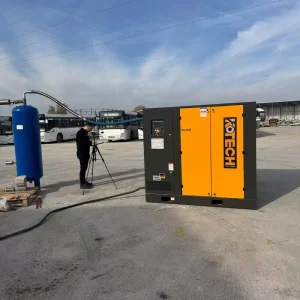
instrument air units
Remote Mine Pad With Limited Grid Power and No Operator on Shift
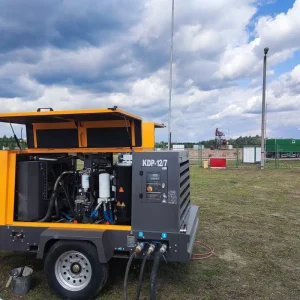
Use a self-contained instrument air unit with a fuel-driven compressor or a hybrid drive. It should include dried air storage, automatic lead control, and enough receiver volume to hold critical valves through a short shutdown. This arrangement fits remote pads where grid power is unreliable, attendance is intermittent, and instrument air supports emergency shutdown or process isolation.
Start with the demand profile, not the nameplate count of devices. List transmitter purge consumption, positioner bleed, solenoid usage, and each actuator’s swept volume. Then add a leakage allowance and a peak factor for several valves moving together. A typical instrument header is held around 6 to 8 bar, but the real criterion is adequate pressure at the farthest device after line and filter losses.
A useful receiver check is V = (Q × t) / ΔP with consistent SI units. Q is the air demand that must come from storage, t is the required hold-up time, and ΔP is the acceptable pressure drop between normal header pressure and the lowest device set point. Convert the result to a receiver size and check it against the actual starting differential pressure. Storage does not replace generation. It buys time for a compressor to start, a standby unit to take over, or a controlled trip sequence to finish.
Recommended package features:
- Fuel-driven prime mover or hybrid drive when grid supply is unstable.
- Refrigerant or desiccant treatment selected for the local minimum temperature.
- Duplex filters or valved bypass arrangements so elements can be changed without taking the header down.
- Automatic condensate drains and a heated or sheltered enclosure in freezing conditions.
- Pressure switches, transducers, and run-fail signalling connected to the site control system.
The main trade-off is fuel and maintenance against availability. A compressor that idles continuously wastes energy and needs service more often. One that starts too often can shorten starter, motor, and dryer life. Storage and a wide but safe pressure band usually give the better balance.
Dusty Processing Plant With Many Cycling Control Valves
Choose a continuously rated, enclosed instrument air package with high-integrity intake filtration, multistage air treatment, a generously sized receiver, and redundant compression trains. This suits crushers, concentrators, transfer stations, and process plants where dust, vibration, and frequent valve cycling create contamination and fluctuating demand.
The compressor room is only part of the environment here. Intake air can carry mineral dust, while the downstream load may include dozens of valve positioners that continuously exhaust small amounts of air. A unit sized for average flow but not peak cycling can show rapid pressure swings, poor valve response, and frequent loading. The compressor should run inside a stable duty band. The receiver should absorb short actuator surges before the next machine starts.
Air treatment should follow the compressor in a logical sequence: aftercooler, moisture separator, particulate filtration, coalescing filtration, and the selected drying stage, with final filtration arranged to protect small instrument passages. Check filter pressure drop at full flow, not just at zero flow. A blocked element can turn an adequately sized compressor into an underpressure event. Differential pressure indication or transducer monitoring gives maintenance staff a clear trigger for an element change.
Conditions that change the selection:
- Ambient dust loading that makes heavy-duty intake prefiltration necessary.
- Heat from nearby equipment that raises compressor inlet temperature and moisture load.
- Valve cycling rates that create repeated short demand peaks.
- Long outdoor headers that can cool saturated air below its dew point.
- A safety instrumented function that requires air during a utility failure.
An oil-lubricated compressor can be acceptable when properly separated, filtered, and monitored. Sensitive instruments or strict plant air-quality rules may favor an oil-free compression arrangement instead. The decision should be based on allowable oil carryover, maintenance capability, and the cost of a contaminated positioner, not simply on compressor purchase cost.
Cold or High-Altitude Site With Outdoor Instrument Air Headers
Select a cold-service instrument air unit with desiccant drying, low-temperature drains, heat tracing or sheltering, and a dew point margin below the lowest expected line temperature. Refrigerant drying alone is usually unsuitable where outdoor piping can fall near or below freezing, because condensed moisture can freeze in filters, solenoid valves, and small tubing.
A practical target is a pressure dew point at least 10 to 15°C below the minimum temperature expected anywhere in the distribution system. The reference must be pressure dew point at the operating header pressure, not atmospheric dew point, because compressed air holds less moisture at elevated pressure. If a dryer is rated at one inlet condition, verify performance at the actual inlet temperature, pressure, and flow. Higher temperature, lower pressure, or overload all reduce effective drying.
Desiccant dryers bring their own design choices. Heatless twin-tower dryers use purge air and are simple to maintain, but the purge loss must be included in compressor capacity. Heated types can reduce purge consumption but add controls, heaters, and service complexity. For small remote packages, the simpler arrangement may be more attractive where fuel is available. In large continuous plants, purge losses can justify a more efficient dryer.
Cold-site checks should include:
- Drain legs and low points where water can collect.
- Heat tracing on wet sections, regulators, and outdoor filter bowls.
- Dryer purge discharge routed so it cannot freeze or pressurize an enclosure.
- Receiver placement in a shelter or above a drain that remains serviceable.
- Pressure relief valves and switches selected for the minimum ambient temperature.
Altitude also affects prime movers and cooling. Naturally aspirated engines lose useful output as elevation rises, and electric motor cooling can be affected by thin air. Select the package for site-rated conditions rather than sea-level nominal capacity. A unit that looks adequate on paper may run hot or fail to recharge the receiver after a large valve sequence.
Continuous Process Area Where Air Loss Forces a Shutdown
Use a redundant, continuously monitored instrument air package with multiple compressors, dedicated drying, protected storage, and automatic changeover. This arrangement fits process areas where loss of air moves control valves to fail position, trips equipment, or prevents safe restart, and where production loss outweighs the cost of standby capacity.
Redundancy should be based on the failure case the site can tolerate. A common arrangement uses lead and standby compressors sized so one machine can carry the essential instrument load while nonessential load is isolated or shed. If every valve must remain operable during maintenance, each compressor and dryer may need to be rated for full demand. If the plant can trip safely, a smaller standby package may be enough to support shutdown and restoration.
Storage is especially valuable in continuous duty. The receiver reduces cycling, smooths short peaks, and supplies air during the few seconds required for automatic changeover. Set start and stop pressures with enough separation to avoid short-cycling, but keep the lowest load pressure above the alarm and trip thresholds of critical devices. A typical control band may span roughly 1 to 2 bar, provided all instruments still receive their required minimum pressure.
Recommended monitoring points:
- Header pressure and receiver pressure.
- Dryer dew point or desiccant cycle status.
- Filter differential pressure.
- Compressor discharge temperature and runtime.
- Condensate drain operation.
- Standby machine power or fuel readiness.
Maintenance access must be planned into redundancy. Isolation valves, bypass lines, spare filter elements, and drain points allow service without disabling the entire utility. A two-compressor skid is not truly redundant if both machines share a single dryer, filter, controller, or drain path with no bypass. Review each common component against the worst-case maintenance and failure scenario.
How the Four Site Setups Compare
The remote pad puts independent power and stored hold-up time first. The dusty plant puts intake protection, treatment capacity, and response to repeated cycling first. The cold site puts pressure dew point, freeze protection, and site-rated compressor output first. The continuous process area puts redundancy, automatic changeover, and elimination of single-point failures first.
| Site condition | Dominant risk | Package emphasis |
|---|---|---|
| Remote, limited power | Failure to start or insufficient hold-up time | Fuel/hybrid drive, storage, remote alarms |
| Dusty, high-cycle plant | Contamination and pressure swings | Heavy-duty filtration, stable control, receiver capacity |
| Cold or high-altitude headers | Freezing, dryer overload, derated drive | Desiccant drying, heat trace, site-rated capacity |
| Continuous critical process | Air loss causes trip or unsafe valve action | Redundant compressors, dryers and changeover logic |
|—|—|—| | Remote, limited power | Failure to start or insufficient hold-up time | Fuel/hybrid drive, storage, remote alarms | | Dusty, high-cycle plant | Contamination and pressure swings | Heavy-duty filtration, stable control, receiver capacity | | Cold or high-altitude headers | Freezing, dryer overload, derated drive | Desiccant drying, heat trace, site-rated capacity | | Continuous critical process | Air loss causes trip or unsafe valve action | Redundant compressors, dryers and changeover logic |
Before choosing among these arrangements, confirm four inputs: minimum pressure at the farthest device, maximum instantaneous air demand, lowest line temperature, and the time the system must survive without the lead compressor. Those four values narrow the choices more reliably than a generic compressor capacity range. If two conditions occur together, such as a remote cold process plant, combine the requirements rather than choosing only one feature set.