off grid compressed air pneumatics
What Off-Grid Pneumatic Systems Must Deliver Without Utility Power
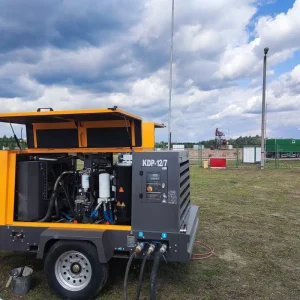
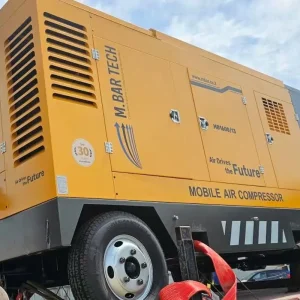
For an off-grid compressed-air system to work reliably, the power source has to feed every tool that runs at once at the pressure they need. Matching only the largest tool is not enough. When demand is continuous, a diesel-driven rotary screw package is usually the best fit for remote mining, drilling, construction, and maintenance work. Battery-electric, hybrid, or renewable-assisted systems are better suited to lower or intermittent loads, especially where ventilation, noise, fuel handling, or idling restrictions matter.
Begin with four field conditions:
- Load profile: continuous drilling, intermittent impact tools, pulsed cylinders, or steady instrumentation air.
- Working pressure: commonly 6–10 bar for general pneumatic tools, with some rock drills or specialized equipment requiring higher pressure.
- Site environment: altitude, dust, cold starts, rain, snow, corrosive air, and restricted ventilation.
- Logistics: fuel delivery, spare-parts lead time, operator skill, and whether the machine can be secured and serviced safely.
An off-grid package is not just a compressor. It needs the prime mover, intake filtration, separation and cooling, pressure regulation, condensate control, outlet filtration, receiver storage, and protection against operation beyond safe temperature or pressure. If the pneumatic load changes during the shift, select the system around the real load profile, not one nameplate rating.
Selection Criteria That Actually Change the Compressor Decision
Calculate demand by listing every pneumatic device that may run at the same time. Multiply each tool’s rated free-air delivery by its use factor, then add leakage and a growth margin. A practical allowance is five to ten percent for leakage on a maintained hose network and ten to fifteen percent for future tools, but avoid stacking both margins blindly on short, single-tool jobs.
Check pressure at the point of use. A tool requiring 6.3 bar may need the compressor set near 7–8 bar after losses through hoses, filters, regulators, quick couplings, and frozen or contaminated lines. Long hoses, undersized fittings, and multiple tees can turn an apparently adequate compressor into an underperforming system.
Use these criteria when comparing options:
- Free-air delivery at site altitude and temperature, not only displacement.
- Pressure band and ability to hold pressure during peak events.
- Continuous duty rating versus intermittent run time.
- Fuel type, fuel cleanliness, tank capacity, and refill interval.
- Starting method and reliable operation below or above the expected ambient range.
- Air-end cooling, filtration, and separation for dusty conditions.
- Receiver volume and wheeled or skid-mounted transport arrangement.
- Service access for oil, filters, belts, batteries, solar panels, or controllers.
Altitude is particularly important because naturally aspirated engines lose available power as elevation increases. A compressor that works at low elevation may need derating or a larger engine package at a high mountain site. Confirm the expected operating envelope instead of assuming sea-level performance.
Off-Grid Power and Compressor Options Compared
| Option | Best load condition | Strengths | Limitations to verify | Typical site fit |
|---|---|---|---|---|
| Diesel rotary screw compressor | Continuous or high-flow pneumatic duty | Mature standalone design, high torque, long run time with fuel supply, suitable for skid or towable use | Fuel logistics, exhaust, noise, routine servicing, cold-start and altitude effects | Remote drilling, mining support, quarry maintenance, continuous rock tools |
| Diesel piston compressor | Low-hour, intermittent demand | Simpler packaging for small loads, often lower installed complexity | More vibration and heat; not ideal for uninterrupted high-duty use | Small crews, backup air, intermittent impact tools |
| Battery-electric compressor with charging source | Short duty cycles, enclosed or noise-sensitive areas | No local exhaust during operation, fewer fuel-handling tasks, responsive control | Limited stored energy; needs generator, solar, or grid charging; battery performance drops in cold weather | Urban-adjacent sites, tunnels, maintenance bays, intermittent shifts |
| Hybrid diesel-battery system | Variable load with long idle periods | Can reduce idling and supply short peaks from stored energy | More components, controls, batteries, and maintenance training | Sites with pulsed demand and strict idle or noise constraints |
| Renewable-assisted compressor with storage | Low predictable demand or auxiliary air | Lower purchased-fuel use when renewable resource is reliable | Weather dependence, large panel or storage footprint, not usually a sole source for high continuous demand | Small instrumentation air, low-duty workshop tools, camps or support facilities |
| Compressor plus larger receiver only | Short peaks above steady average demand | Storage can satisfy brief tools without a larger prime mover | Receiver does not create energy; compressor must refill between peaks | Nailers, impact wrenches, actuators, intermittent drilling cycles |
|—|—|—|—|—| | Diesel rotary screw compressor | Continuous or high-flow pneumatic duty | Mature standalone design, high torque, long run time with fuel supply, suitable for skid or towable use | Fuel logistics, exhaust, noise, routine servicing, cold-start and altitude effects | Remote drilling, mining support, quarry maintenance, continuous rock tools | | Diesel piston compressor | Low-hour, intermittent demand | Simpler packaging for small loads, often lower installed complexity | More vibration and heat; not ideal for uninterrupted high-duty use | Small crews, backup air, intermittent impact tools | | Battery-electric compressor with charging source | Short duty cycles, enclosed or noise-sensitive areas | No local exhaust during operation, fewer fuel-handling tasks, responsive control | Limited stored energy; needs generator, solar, or grid charging; battery performance drops in cold weather | Urban-adjacent sites, tunnels, maintenance bays, intermittent shifts | | Hybrid diesel-battery system | Variable load with long idle periods | Can reduce idling and supply short peaks from stored energy | More components, controls, batteries, and maintenance training | Sites with pulsed demand and strict idle or noise constraints | | Renewable-assisted compressor with storage | Low predictable demand or auxiliary air | Lower purchased-fuel use when renewable resource is reliable | Weather dependence, large panel or storage footprint, not usually a sole source for high continuous demand | Small instrumentation air, low-duty workshop tools, camps or support facilities | | Compressor plus larger receiver only | Short peaks above steady average demand | Storage can satisfy brief tools without a larger prime mover | Receiver does not create energy; compressor must refill between peaks | Nailers, impact wrenches, actuators, intermittent drilling cycles |
Worked Sizing Example for a Remote Pneumatic Tool Set
Assume a remote crew expects to run one rock drill, one impact wrench, and a small air-driven pump at the same time. Their free-air demands are:
- Rock drill: 3.0 m³/min at 7 bar, use factor 0.80.
- Impact wrench: 1.2 m³/min at 6.3 bar, use factor 0.50.
- Pneumatic pump: 0.8 m³/min at 6 bar, use factor 0.90.
Average simultaneous demand is: (3.0 × 0.80) + (1.2 × 0.50) + (0.8 × 0.90) = 2.40 + 0.60 + 0.72 = 3.72 m³/min.
Add a ten percent leakage and maintenance allowance: 3.72 × 1.10 = 4.09 m³/min.
The compressor should therefore deliver about 4.1 m³/min of free air under site conditions. A practical selection target is around 4.3–4.6 m³/min if the tools often overlap or additional short-use tools are likely. The pressure setting must allow for line loss. If the highest tool needs 7 bar and hoses, filters, and couplings lose 0.5–0.8 bar, the compressor should maintain roughly 7.5–8 bar at its outlet while remaining within the tool and piping ratings.
Receiver sizing can be checked with the simplified relationship: V = C × t × (Pa + 1) ÷ ΔP where V is receiver volume in cubic metres, C is allowable air demand in m³/min, t is time in minutes, Pa is atmospheric pressure in bar absolute, and ΔP is the allowed pressure drop in bar.
For a 0.5-minute peak of 1.0 m³/min above compressor output, using atmospheric pressure of about 1 bar absolute and allowing a 1 bar pressure drop: V = 1.0 × 0.5 × (1 + 1) ÷ 1 = 1.0 m³.
This shows why a receiver can cover a short peak, but it cannot replace compressor capacity during a long continuous draw. The example also confirms that a diesel screw package is more appropriate than a small battery-only unit when all three tools can run together for most of a shift.
Which System Fits Different Remote Site Conditions
Choose a diesel-driven rotary screw compressor when pneumatic demand is high, tools run for long periods, and fuel can be delivered and stored safely. Specify it with heavy-duty intake filtration, appropriate cooling, fuel-water separation, cold-start provisions where needed, and a service plan based on actual hours rather than calendar time alone. Keep hoses routed away from traffic, sharp edges, heat, and standing water.
Choose a battery-electric or hybrid package when the load is intermittent, local exhaust is unacceptable, or long idling is a concern. These systems need a realistic recharge plan: a small diesel generator, solar array with backup generation, or another reliable charging source. Compare total stored energy in kWh against compressor power in kW and expected run minutes; rated motor horsepower alone does not predict shift endurance.
Choose additional receiver storage when the average load is manageable but peaks are short. This is common with impact wrenches, nailers, clamping cylinders, and pulsed actuators. Verify that the receiver is rated for the pressure, protected by a safety relief valve, drained regularly, and installed so condensate cannot freeze or enter tool lines.
Do not select from a single CFM number. The final decision should pass five checks: simultaneous flow, point-of-use pressure, site derating, continuous duty, and serviceability. If any one fails, the cheapest or most compact package can become the limiting resource on site.
Field Checks Before Committing to an Off-Grid Pneumatic Package
Before purchase or hire, request the expected air demand of every tool in both CFM and m³/min, along with its minimum operating pressure, hose size, and duty pattern. Mark which tools can realistically run together, then calculate demand at the coupling rather than from a theoretical full-load schedule. This prevents both undersizing and paying for an oversized compressor that idles for much of the shift.
Inspect the proposed layout for:
- Minimum hose internal diameter and total length, especially runs over 30 m.
- Quick-coupler pressure drop and compatibility across the tool fleet.
- Slope and drain points so water does not collect in low spots.
- Distance from exhaust, heat sources, and combustible fuel storage.
- Access for fueling, oil checks, filter changes, and receiver drainage.
- Clearance around coolers and intake air in dusty or hot locations.
- Lifting, towing, tie-down, and ground-bearing conditions.
For cold sites, confirm starting aids, battery capacity, lubricant grade, condensate handling, and hose flexibility. For hot sites, verify cooling margin and the risk of thermal shutdown. For high-altitude sites, request derated engine and compressor output. These checks are more useful than comparing nominal horsepower because they determine whether the pneumatic system will maintain pressure during the actual shift.
Buyer Guide
- Verify simultaneous free-air demand in CFM or m³/min.
- Confirm pressure at the tool after hose and filter losses.
- Require altitude and temperature derating for remote sites.
- Match duty cycle to continuous-rated or intermittent equipment.
- Check fuel logistics, charging infrastructure, and service access.
- Use receiver storage for short peaks, not as a substitute for capacity.
Pitfalls to Avoid
- Selecting by horsepower or displacement instead of delivered free air.
- Ignoring pressure loss in long hoses and multiple quick couplings.
Using a sea-level compressor rating at high altitude without derating.
- Omitting leakage and condensate control in cold or dusty environments.
- Expecting a receiver to support continuous demand beyond compressor output.
- Choosing battery storage without calculating recharge time and kWh use.