what applications are tow-behind air compressors suitable for
Remote Exploration Drilling and Sampling Without Grid Power
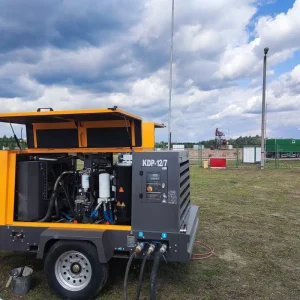
Tow-behind air compressors work well for remote exploration drilling, core support, reverse-circulation sampling, shallow-hole work, and other short-duration jobs where the rig moves from pad to pad. Use this option when the site has no permanent power, the drilling program moves through several locations, and the access roads or drill pads can safely carry a towed unit. A typical cutoff is relocation every few days or weeks, rather than leaving one machine on a fixed pad for most of its service life.
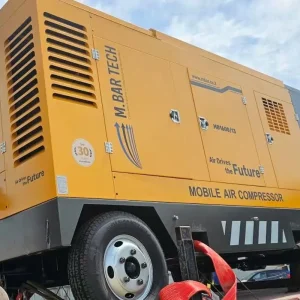
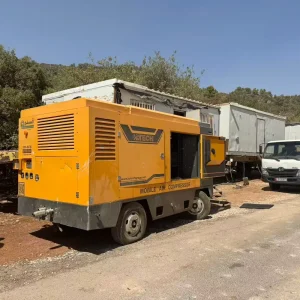
The standard setup is a diesel-driven rotary-screw compressor towed by a suitable site truck or prime mover. When terrain allows, place it upwind of dust and exhaust. It needs to sit level for stable operation and reliable fuel pickup, with clear space around the intake, cooler, and service panels. Keep hose length as short as practical. Every metre of undersized hose adds pressure loss and can reduce drilling performance. If the tool needs roughly 7 bar at its inlet, the compressor outlet may have to be set higher to allow for filters, hoses, fittings, and short periods of peak demand.
This type of application puts mobility ahead of a permanent installation. One mobile package can supply the drill, blowdown, sampling cleanup, and ancillary air motors. Before moving it, check that the tow hitch, lighting, brakes, and tyres meet site road rules. Allow time for cool-down and a secure shutdown before towing. For very high flow or continuous high-pressure drilling, a dedicated skid-mounted or truck-mounted package can be more stable than a general-purpose tow-behind unit.
Blasting, Percussive Tools and Intermittent Peak Demand
Use a tow-behind compressor when several workers run jacklegs, stopers, hand-held rock drills, chipping guns, air lances, or similar percussive tools around a bench, development face, or maintenance area. It is a good match when demand is intermittent, the work face advances, and the compressor can be parked close enough to avoid long hose networks. It is not as suitable for continuous, round-the-clock production in one fixed location.
Size the package by adding the air consumption of tools that will run together. Then add a practical margin for simultaneous startup, hose leakage, and peak loading. A simple planning method is: rated tool flow multiplied by the number of tools, adjusted by a simultaneous-use factor. For example, two tools each requiring about 3 m³/min do not always use the full 6 m³/min continuously. Even so, sizing the compressor too close to the average can cause pressure to collapse when both tools are throttled at once. Check pressure at the tool coupling, not just at the compressor outlet.
The recommended setup includes:
- a regulator or receiver arrangement where tools cycle sharply;
- oil-water separation or filtration where air quality matters; and
- properly rated quick couplings near the work area.
Route hoses away from vehicle traffic, sharp rock, and hot equipment. A tow-behind machine gives crews one shared air source that can follow the face. However, excessive hose length, undersized couplings, or too many connected tools can make a properly rated compressor seem underpowered.
Pipeline, Tie-In and Field Maintenance Work Spread Along a Corridor
Tow-behind compressors are suited to pipeline and field maintenance work that moves along a corridor. Typical jobs include pneumatic cutting or grinding, weld preparation, bolt tensioning support, purging assistance, valve operation, debris clearing, and leak-survey support. They fit jobs where each work zone covers a limited area and the compressor has to move between access points, valve stations, or tie-ins. They should not replace a dedicated high-pressure test pump for hydrostatic or pneumatic proof testing. Compressed air used for testing needs separate risk controls and pressure-rated equipment.
The recommended setup is a road-tow or site-tow compressor outside the excavation footprint. It should sit on stable ground, have visible access for fuel delivery, and direct exhaust away from workers and confined-space openings. For intermittent tool use, a receiver tank can reduce rapid cycling and supply short peaks of air. In cold weather, select a configuration rated for low ambient temperatures, including the right fuel, condensate management, and warm-up procedures. In hot conditions, position the unit so cooling air is not recirculated from nearby equipment.
A key check is the actual pressure at the farthest work point. If a tool needs 6.5 bar and the hose run is long, pressure loss may leave too little working pressure even when the compressor gauge looks normal. Increasing hose diameter is often more effective than raising outlet pressure, which can increase fuel use and heat. Pipeline corridors may involve public roads, permit-controlled access, and narrow right-of-way tracks. Before selecting the unit, verify towing width, ground clearance, and brake requirements.
Temporary Backup Air for Plant Shutdowns and Commissioning
A tow-behind compressor can provide temporary backup or supplemental compressed air during stationary-compressor maintenance, plant shutdowns, commissioning, instrumentation-air support, and short production bottlenecks. Use this approach when the need is finite, connection points are available, and the mobile unit can be brought to site without building a permanent foundation. It works best for planned events or emergency cover where some loss of redundancy is acceptable under managed procedures.
Connect through a properly sized temporary header or tie-in. Do not feed several small hoses independently. Confirm the required pressure band, air quality, duty cycle, and whether the plant needs dry or filtered air. If the temporary compressor supplies instrument air, an aftercooler, separator, and suitable filtration are normally necessary. Untreated wet air can damage controls, freeze in cold lines, or contaminate process equipment. A receiver can help with short peaks, but it cannot make an undersized compressor suitable for continuous demand above its rated flow.
Before use, calculate the connected load and compare it with the available mobile capacity. Include derating for altitude, high temperature, and accessory pressure drop. A common planning rule is to keep normal demand below the compressor’s sustainable continuous range rather than relying on short-term peak capability. Agree on fuel storage, exhaust discharge, fire separation, and noise location before placement. If temporary duty becomes permanent, or if use approaches full-time operation, a stationary compressor with fixed cooling, ventilation, and condensate handling is usually the lower-risk installation.
When a Tow-Behind Unit Is the Better Practical Choice
Tow-behind compressors offer the most value when mobility matters more than fixed-plant efficiency. They fit multi-pad exploration, advancing work faces, scattered maintenance jobs, and temporary support because existing site vehicles can move them and they can be connected without civil works. Their limits show up with continuous duty, steady loads, sites that towed equipment cannot reach, or enclosed areas where emissions and noise must be tightly controlled.
The main selection checks are flow, pressure, duty cycle, and site access:
- Flow: add simultaneous tool or process demand in CFM or m³/min, and include leakage and startup peaks.
- Pressure: confirm pressure at the point of use after losses in hoses, filters, dryers, and couplings.
- Duty: intermittent and variable loads favor a mobile unit; steady, high-utilization loads favor fixed compression.
- Environment: altitude, heat, cold, dust, and corrosive conditions may require derating, special filtration, or colder-climate provisions.
- Access: muddy tracks, steep ramps, narrow roads, or soft pads can rule out a towed plant even if the compressor has enough air capacity.
A useful comparison is that drilling and face-tool work usually needs mobility and tolerance for variable loads; corridor work needs road access and manageable hose runs; and backup plant duty needs clean temporary tie-ins and predictable air quality. If the unit will remain in one place, run almost continuously, or supply critical process controls, evaluate a stationary compressor before choosing a tow-behind package.
Implementation Checklist
- Inspect tyres, hitch, safety chains, brakes and lights before towing.
- Check engine oil, coolant, fuel, compressor fluid, intake restriction and separator condition.
- Position the unit on level ground away from dust, exhaust recirculation and vehicle traffic.
- Route and secure hoses, then test pressure at the farthest point of use.
- Verify isolation, tie-in points, condensate drainage and fire/noise separation for temporary plant use.
Use Cases
- Remote exploration drilling and sampling pads without electrical power
- Jacklegs, stopers, rock drills and other intermittent percussive tools
- Pipeline corridor maintenance, weld preparation, valve operation and cleanup
- Temporary plant backup during shutdowns, commissioning or stationary-compressor servicing
Buyer Guide
- Calculate simultaneous flow demand in CFM or m³/min and verify pressure at the tool connection.
- Confirm towing capacity, hitch type, brakes, lighting, width and ground clearance for site roads.
- Review altitude and temperature derating, fuel type, dust filtration and cold-start provisions.
- Decide whether aftercooling, receivers, dryers or additional filtration are required.
- Compare expected utilization: frequent relocation favors tow-behind; continuous fixed duty favors stationary equipment.
Pitfalls to Avoid
- Sizing from the largest single tool instead of simultaneous demand
- Reading pressure only at the compressor outlet while ignoring hose losses
- Parking on soft or sloping ground with poor ventilation and exhaust clearance
- Using untreated portable compressor air for sensitive instrument-air duties
- Assuming road-tow running gear is suitable for unmaintained off-road tracks