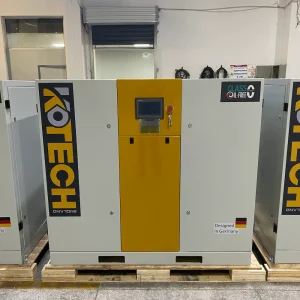

Unlocking Mining Profitability: The VSD Compressor Advantage
In the demanding world of mining, every operational dollar counts, and nowhere is this truer than in the power consumption of critical equipment. Air compressors, often considered a necessary utility, are frequently overlooked as a significant drain on profitability. However, the adoption of Variable Speed Drives (VSDs) on these workhorses represents one of the most impactful upgrades available to improve your bottom line. Simply put, VSDs directly tackle the biggest cost driver of compressed air: energy.
Here are the key insights into how VSDs dramatically improve mining air compressor ROI:
- Extended Equipment Lifespan: Reduced stress on motors and components from smoother operation and fewer start-stop cycles lowers maintenance needs and extends the compressor’s operational life.
- Enhanced Operational Flexibility: Seamlessly adapting to varying air demands across different mining phases or shifts ensures optimal performance without wasted energy or pressure drops.
- Lower Total Cost of Ownership (TCO): Combining energy savings with reduced maintenance and longer asset life results in a compelling financial advantage over traditional systems.
The Unseen Drain: Why Traditional Compressors Fail Mining ROI
Mining operations are inherently dynamic. Air demand fluctuates wildly throughout a shift, depending on the specific tasks: drilling, pneumatic tool use, ventilation, or material handling systems. Conventional fixed-speed compressors operate at full capacity regardless of actual demand. When demand drops, these units either cycle on and off frequently (leading to wear and tear) or vent excess compressed air into the atmosphere, a process known as “unloading.” Both scenarios are incredibly wasteful.
That wasted energy isn’t theoretical; it’s a tangible cost. For a piece of equipment running 24/7 in a remote mining environment, this translates to hundreds of thousands of dollars annually, often without operators fully realizing the extent of the loss. The continuous starting and stopping also introduces mechanical stress, leading to premature component failure and unexpected downtime – a cardinal sin in mining where every minute of lost production is lost revenue.
Data Speaks: The Compelling Case for VSD Adoption
The argument for VSDs isn’t just theoretical; it’s backed by hard numbers from the field. In mining, where demand profiles are rarely constant, this figure can easily climb higher.
Reduced Maintenance & Extended Life: Beyond energy, VSDs protect your investment. The soft start capabilities and reduced cycling minimize mechanical shock on the motor, bearings, and other critical components. This directly translates to fewer breakdowns and less frequent maintenance interventions.
Rapid ROI: The payback period for upgrading to a VSD compressor, or retrofitting an existing unit, is often surprisingly short. While initial capital expenditure might be higher, the energy savings alone typically offset this cost within 18 to 36 months, depending on electricity rates and duty cycle, as noted in various industry analyses, including those from EIA data on industrial energy consumption up to 2023.
How VSDs Deliver Tangible ROI: Beyond Energy Savings
The core principle behind VSD efficiency is simple yet powerful: they vary the motor speed to precisely match the compressed air output to the current demand. This eliminates the wasteful unloading cycles and constant full-speed operation of traditional compressors. The drive adjusts the motor frequency, thus controlling its speed and the volume of air produced. This demand-side management is the cornerstone of improved ROI.
Precision Pressure Control
VSDs maintain a much tighter pressure band than fixed-speed units. This isn’t just about efficiency; it improves the performance and lifespan of pneumatic tools and equipment downstream. Consistent pressure means better tool performance, reduced wear on air-powered machinery, and fewer disruptions due to pressure drops. This fine-tuned control prevents over-pressurization, which consumes excess energy, and under-pressurization, which can halt production.
Reduced Mechanical Stress and Noise
The smooth acceleration and deceleration of a VSD motor significantly reduce mechanical stress on the compressor’s internal components. This translates to less vibration, lower operating temperatures, and ultimately, fewer breakdowns. Furthermore, by operating at lower speeds when demand is low, VSD compressors often run quieter, contributing to a better working environment—a small but important detail that improves compliance and worker comfort.
When VSDs Aren’t the Silver Bullet: Important Considerations
While VSD technology offers immense benefits, it’s crucial to understand its optimal application. VSDs are most effective in applications with fluctuating air demand. In such niche scenarios, the higher initial capital cost of a VSD might not yield the rapid ROI seen in more dynamic environments.
Additionally, the electrical infrastructure needs to be robust enough to handle the VSD. Harmonic distortion can be a concern, though modern VSDs often come with integrated filters to mitigate this. It’s always wise to consult with an experienced compressed air system integrator to assess your specific site conditions and demand profile before making a significant investment. Old-school fixed-speed units still have their place, but only when carefully justified by a truly constant load.
Implementing VSDs: A Practical Roadmap for Mining Operations
Integrating VSD technology into your mining operation requires a strategic approach. It’s not just about swapping out one compressor for another; it’s about optimizing your entire compressed air system.
- Conduct a Professional Air Audit: Start with a comprehensive audit of your current compressed air system. This will map your actual air demand profile, identify leaks, and pinpoint inefficiencies. This data is indispensable for sizing the right VSD compressor and calculating potential savings.
- Right-Sizing is Key: Don’t just replace your existing compressor with a VSD of the same horsepower. The audit data will help determine the optimal size, ensuring maximum efficiency without over- or under-sizing.
- Consider Hybrid Systems: For operations with both fluctuating and occasional peak demands, a hybrid system combining a VSD compressor with a fixed-speed base-load unit can offer the best of both worlds. The VSD handles the variations, while the fixed-speed unit provides a constant, efficient base supply.
- Focus on System Integration: Ensure the VSD compressor integrates seamlessly with your existing SCADA or control systems. Modern VSDs offer advanced connectivity for remote monitoring and predictive maintenance, further enhancing ROI by preventing unexpected downtime.
- Prioritize Training and Support: Invest in training your maintenance staff on VSD technology. Proper operation and preventative maintenance are critical to realizing the full benefits and maximizing the lifespan of your investment.
The initial investment is quickly dwarfed by the long-term operational savings, making it a no-brainer for any forward-thinking mining operation.