
- Unconventional onshore shale operations need upgraded dust filtration that does not apply to low-volume stripper wells.
- Only Class 1 Division 1 rated units are approved for hazardous wellhead zones on both site types.
Most air compressor failures in oil & gas stem from mismatched specs, not poor equipment quality.
Core Site-Specific Requirements
Offshore Oil & Gas Site Needs
Offshore platforms face harsher ambient conditions than any onshore operation. Constant salt spray, high humidity, and limited access for maintenance create non-negotiable specs.
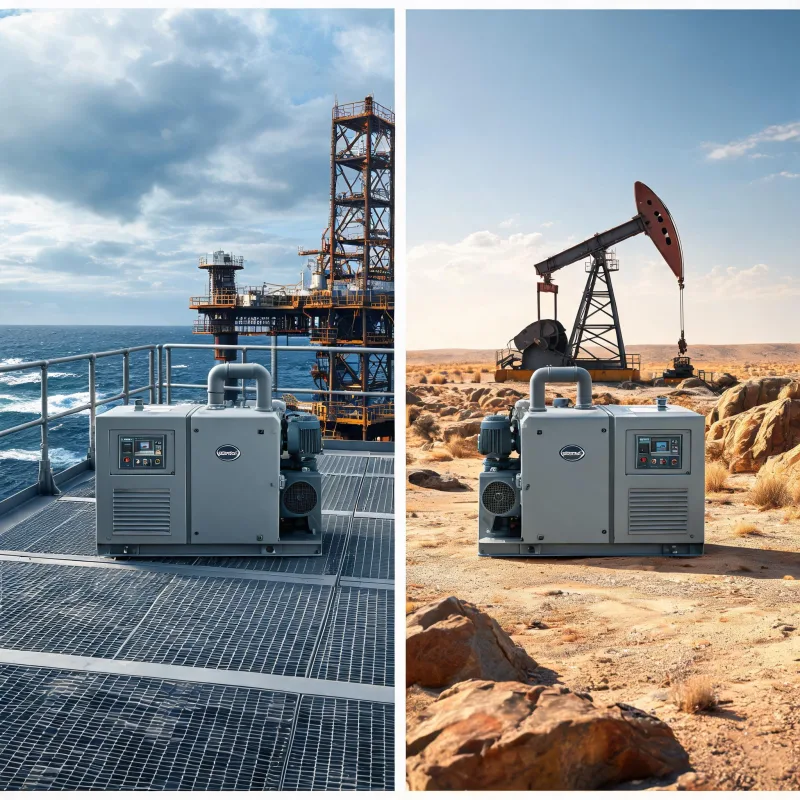
Most standard industrial compressors lack the marine-grade epoxy coating and 316 stainless steel internal components needed to withstand salt exposure.
This requirement does not apply to small nearshore onshore-connected wellhead platforms that have weekly maintenance access, where lower-grade coating can deliver acceptable service life.
Onshore Oil & Gas Site Needs
Onshore site requirements vary far more than offshore, based on production type and location.
Shale well pads are often located in arid, dusty regions, and unfiltered air can cause valve wear and internal component damage within 12 months.
Conventional onshore production and refinery auxiliary operations have different needs. They typically require lower upfront capital, and can accommodate more frequent maintenance intervals than offshore units.
Actionable Selection Guidance
When selecting a unit for a new site, start with zoning classification first. Any unit placed in a Class 1 Division 1 hazardous zone must have full explosion-proof certification from a recognized body like ATEX or CSA.
For offshore sites, confirm corrosion resistance specs before looking at flow rate. Many buyers prioritize flow rate first and cut corners on coating, which leads to early failure.
For onshore shale sites, upgrade the standard 20 micron filtration system to 10 micron or lower.
Implementation Checklist
- Confirm hazardous area classification before selection
- Verify corrosion resistance matches site conditions
- Match filtration to site particulate levels
- Confirm uptime aligns with maintenance access frequency
- Validate third-party explosion-proof certification
Use Cases
- Offshore drilling platforms
- Offshore production platforms
- Onshore shale well pads
- Onshore conventional oil extraction
- Refinery compressed air systems
- Natural gas processing plants
Buyer Guide
1. Start with hazardous area classification to narrow approved units 2. Match corrosion resistance to site ambient salt exposure 3. Select filtration rating based on site particulate levels 4. Confirm uptime aligns with maintenance access frequency 5. Compare total cost of ownership, not just upfront cost
Specs Snapshot
- Offshore corrosion spec: Marine-grade epoxy, 316SS internals
- Onshore shale filtration: 10 micron minimum
- Hazardous zone rating: Class 1 Division 1 (ATEX/CSA certified)
Pitfalls to Avoid
- Do not cut corners on corrosion protection for offshore sites
- Do not use standard filtration for arid onshore shale operations
- Do not skip third-party certification for explosion-proof units
- Do not ignore maintenance access when selecting uptime rating




