
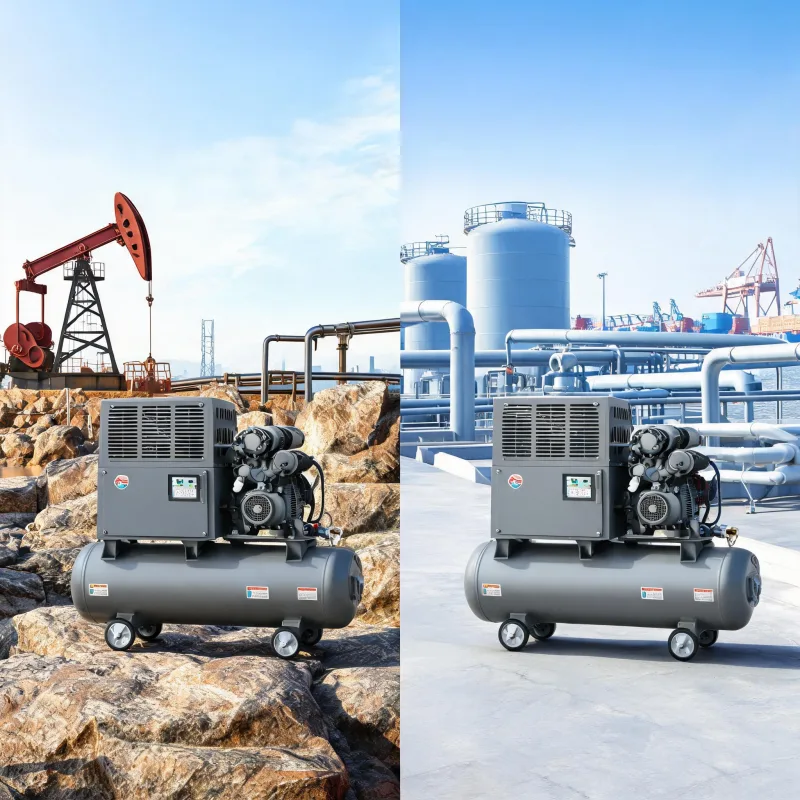
Which Compressor Type Fits Best for Oil & Gas Operations
- Oil-free centrifugal models are required for high-capacity downstream refining and natural gas processing
- Reciprocating compressors only fit low-volume, intermittent site use and are not ideal for continuous operation
Most oil and gas operations get the best long-term value from rotary screw compressors. Only high-volume downstream or specialized processing require centrifugal models. Reciprocating units work only for small, intermittent sites.
Core Application Breakdown by O&G Segment
Upstream operations including drilling, well testing, and wellhead instrumentation demand reliable air supply that can handle variable site conditions and often continuous runtime.
Midstream operations including pipeline valve actuation, storage terminal instrumentation, and pressure control also rely on consistent, continuous airflow. Most midstream sites fall into the 100 to 4000 CFM range that matches rotary screw compressor capabilities perfectly.
Downstream refining and natural gas processing have far higher airflow requirements for process air, and any oil contamination can ruin product quality. These applications almost always require large-capacity, oil-free centrifugal compressors.
Continuous runtime is the biggest deciding factor for any selection. Any application running 24/7 needs a model rated for continuous duty. Reciprocating units don’t meet that standard for most operations.
Performance Data by Compressor Type
For high-volume operations, this efficiency difference adds up to tens of thousands of dollars in annual energy cost savings.
Rotary screw compressors are not suitable for applications requiring over 5000 CFM of continuous airflow.
Actionable Selection Rules for Operators
If your site has a maximum airflow requirement under 5000 CFM and runs more than 4 hours per day, rotary screw is the clear best choice. Choose oil-injected for general site use, and oil-free if you need process air that contacts product.
If your site needs over 5000 CFM of continuous airflow for refining or natural gas processing, select an oil-free centrifugal compressor. The higher upfront cost will pay back in 3 to 5 years via lower energy and maintenance costs.
Only select a reciprocating compressor if your site is remote, requires less than 100 CFM, and runs less than 4 hours per day. Even in this use case, compare long-term maintenance costs before purchasing, as some small rotary screw models have lower total cost of ownership over 10 years.
That mistake could’ve been avoided by sticking to these simple selection rules.
Common Cost Mistakes to Avoid
Most purchasing decisions focus too heavily on upfront cost rather than total lifetime ownership cost.
Implementation Checklist
- Confirm site maximum CFM requirement and daily runtime
- Verify if oil contamination is allowed for your application
- Check local compliance standards for process air quality
- Compare 10-year total cost of ownership, not just upfront price
- Confirm the unit is rated for your required runtime
Decision Guide
| Daily Runtime | Required CFM | Recommended Type |
|---|---|---|
| <4 hours | <100 CFM | Reciprocating |
| Any | 100-5000 CFM | Rotary Screw |
| 24/7 | >5000 CFM | Centrifugal |
|—————|————–|——————| | <4 hours | 5000 CFM | Centrifugal |
Use Cases
- Upstream onshore drilling and well site operations
- Midstream pipeline valve actuation and storage terminals
- Downstream refinery process air and plant utilities
- Natural gas processing and treatment operations
- Remote well pad intermittent utility use
Pitfalls to Avoid
- Do not buy a reciprocating compressor just for lower upfront cost if you need continuous duty
- Do not underestimate required CFM for future site growth
- Do not use oil-injected compressors for product-contact applications
- Do not ignore long-term maintenance requirements when comparing options
Cost Factors
- Centrifugal compressors have higher upfront cost but lower energy cost for high flow




