
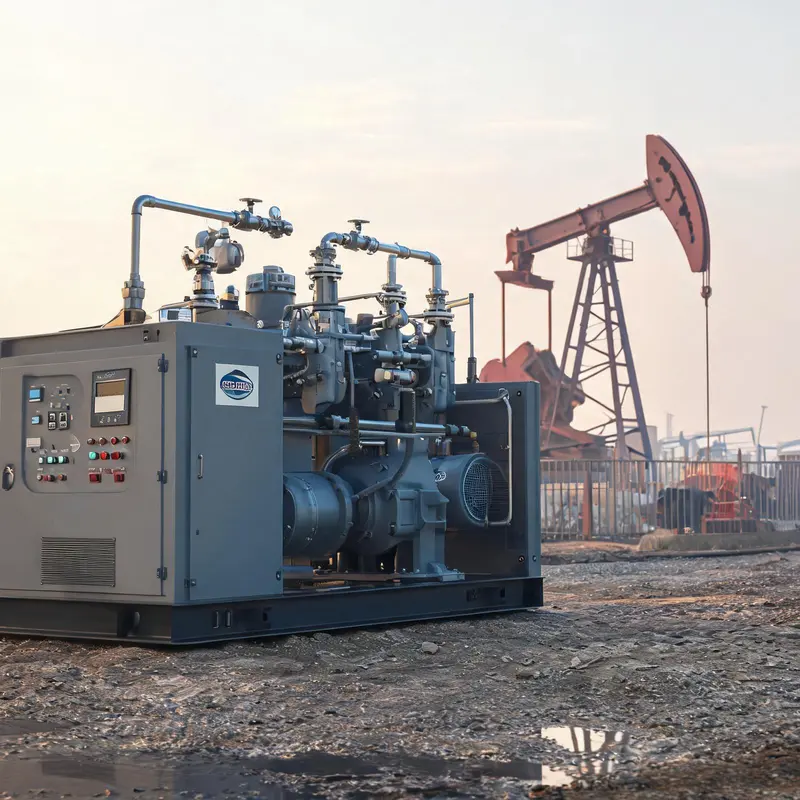
nitrogen booster compressor selection for well unloading
Why well unloading sets demanding requirements for a nitrogen booster
Well unloading uses pressurized nitrogen to reduce hydrostatic pressure in the fluid column, initiate flow and help a well return to natural production. Unlike routine plant air duty, the service often combines high discharge pressure, variable flow demand, remote locations and intermittent high load. A nitrogen booster compressor selected only for its maximum pressure rating may still be unsuitable if it cannot maintain flow during the full unloading sequence.
The booster normally receives nitrogen from a nitrogen generator, storage bank or low-pressure supply and raises it to the pressure required at the wellhead or coiled-tubing unit. The equipment must follow a controlled pressure ramp, hold stable delivery pressure and respond when fluid movement begins. Load changes can occur quickly as gas enters the tubing, fluid aerates and backpressure shifts.
Buyers should therefore evaluate the complete operating profile: initial breakover pressure, sustained flow period, expected final pressure, ambient temperature and duty cycle. A package intended for occasional, short-duration use should not be presented as a continuous-duty solution. The most practical selection starts with the well program, not with a compressor catalog rating.
A suitable booster should also be compatible with nitrogen service. Materials, seals, lubrication and valve design must handle dry, inert gas without excessive heat buildup or contamination. Dry gas can change sealing behavior and lubrication conditions, so packages designed primarily for atmospheric air may require modification or careful application review.
How to define pressure and flow requirements before sizing equipment
Pressure and flow are the two primary sizing inputs. Pressure must be sufficient to overcome the fluid column and wellbore restrictions, while flow must be high enough to lighten the column and sustain unloading at the planned rate. These values should be developed from well depth, fluid density, tubing or casing size, wellhead pressure, friction losses and the chosen injection method.
A useful starting point is to separate minimum starting pressure from operating pressure. Starting pressure may be high when the column is static, but sustained flow can require a different balance of pressure and volume. Sizing to peak pressure alone can produce a package with inadequate flow; sizing to peak flow alone can leave insufficient pressure to initiate lift.
Typical high-pressure nitrogen unloading packages may operate over a wide range, often from several hundred to more than a thousand bar at the upper end in demanding services, with lower pressures used for conventional well kickoff. Rather than requesting a generic high-pressure unit, provide the expected pressure-flow curve, injection duration and standby periods. This allows the supplier to select stage count, cylinder or screw configuration, drive power and cooling capacity.
Flow should be stated in actual delivered nitrogen volume, not only compressor inlet displacement. Pressure drop through hoses, filters, coolers, relief valves and metering equipment should be included. If the program may include coiled tubing, pipeline purge, stimulation support or reservoir activation later, the package should have a usable operating envelope across those duties without operating near its limits continuously.
Nitrogen source, purity and conditioning requirements
A booster is only one part of the nitrogen delivery system. The feed gas source must provide stable inlet pressure and enough volume to prevent starvation during high-demand periods. Feed can come from membrane or PSA nitrogen generators, liquid nitrogen vaporization, cylinder racks or storage vessels. Each source has different pressure stability, temperature, purity and moisture characteristics.
Nitrogen purity should match the well objective. Oxygen contamination can create corrosion, oxidation or safety concerns, especially in hydrocarbon-producing wells. The selected purity should be maintained not just at steady flow but also during startup, load changes and low-flow periods. If a generator feeds the booster directly, its response time and turndown capability should match the compressor control system.
Gas conditioning is equally important. Dry nitrogen may be clean, but field packages can still introduce particulates, compressor oil carryover, water after maintenance or heat from compression. Inlet filtration, knockout capability, pressure regulation and temperature monitoring help protect booster stages and downstream equipment. For sensitive wells, oil-free compression or effective oil removal and monitoring may be required.
The suction envelope must be confirmed with the supplier. A booster designed for a narrow inlet pressure range may trip or lose efficiency if the nitrogen source pressure decays. Buffer tanks, priority controls, recirculation lines or load-sharing arrangements can smooth supply. The final specification should identify inlet pressure range, nitrogen purity, dew point, allowable particulate level, maximum inlet temperature and permitted oil content.
Comparing drive type, cooling and package configuration
The drive should match site utilities and location. Diesel-driven packages are common where grid power is unavailable or where the unit must move between well pads. Electric drives can be suitable for fixed facilities, offshore modules or sites with strict emissions and noise limits. Gas-driven options may be considered where approved fuel gas is available, but fuel quality, ventilation and safety systems require careful review.
Cooling selection depends on ambient conditions and duty. Air-cooled packages are simpler to mobilize but need adequate airflow and can be affected by high ambient temperature, recirculation and enclosure restrictions. Liquid-cooled systems may provide steadier temperatures in hot, confined or offshore environments but add coolant circuits, heat exchangers and maintenance points. High discharge temperature is a common limiting factor, so cooling should be evaluated at the worst-case site condition.
Package layout should support transport and rig-up. Trailer, skid, truck-mounted or modular frames each have different road limits, lifting requirements, footprint and hook-up time. Controls, discharge connections, fuel fill points, filters and oil service points should remain accessible after installation. On offshore or congested locations, lifting weight, corrosion protection, zone rating and ventilation may dominate the decision.
Instrumentation should provide clear pressure and temperature visibility, shutdown logging and controlled loading. Manual controls can be adequate for simple operations, but integrated electronic controls improve repeatability and equipment protection. Remote monitoring may be useful, but local emergency stop, pressure relief and independent overpressure protection remain essential regardless of automation level.
Safety systems and operational risks in nitrogen unloading
Nitrogen unloading combines high-pressure gas, inert atmosphere and hydrocarbon well conditions. Overpressure is the most immediate equipment risk. The package should include properly sized relief devices, discharge isolation capability, pressure transmitters, gauges and independent shutdown logic. Relief points must discharge to a safe location, away from personnel, hot surfaces and combustible materials.
High-pressure hoses, fittings and piping require correct pressure rating, compatible materials and periodic inspection. Connection discipline is especially important because transient flow, vibration and repeated rig-up can loosen fittings or fatigue components. Whip protection, proper torque practices, isolation valves and pressure venting procedures reduce exposure during connection and disconnection.
Asphyxiation is a major hazard because nitrogen is odorless and does not provide visible warning of oxygen displacement. Enclosed spaces, cellars, offshore modules, exhaust routes and purge discharge areas need ventilation planning, oxygen monitoring and restricted access. Personnel should understand that vented nitrogen, even from a seemingly normal shutdown, can collect in low or poorly ventilated spaces.
Fire and ignition risks should also be addressed, particularly on diesel packages near wellheads. Spark arrestors, exhaust shielding, shutdown systems, grounding and equipment placement may be required. Gas detection and emergency shutdown interfaces should connect with site systems when applicable. The supplier should provide operating limits, maintenance instructions and certification documents appropriate to the area classification and local safety regime.
Maintenance, reliability and total cost considerations
A well-unloading booster often sits idle, then must perform immediately under demanding conditions. Maintenance planning should therefore address both operating hours and calendar time. Seals, hoses, valves, filters and coolers can degrade even with limited running time, especially in humid, salty, dusty or vibrating field environments.
Typical service tasks include valve inspection, lubricant analysis or replacement, filter changes, cooler cleaning, pressure gauge calibration, relief-device verification and leak checks. Service intervals vary by design and duty; common routine inspections may occur monthly or every few hundred operating hours, while major valve and seal service may occur annually or after several thousand hours. The supplier should provide a realistic schedule for both standby and continuous operation.
Reliability improves when wear parts are accessible and standard consumables are available locally. Buyers should ask about lead times for valves, seals, filters, sensors and coolers. A technically capable package can become a costly delay if specialized parts must be moved long distances during a well operation. Rental can reduce ownership exposure, but long-term or repeated use may favor purchase with a structured spare-parts plan.
Total cost should include purchase or rental rate, fuel or power consumption, transport, certification, operator training, consumables, overhaul intervals and expected residual value. Cheaper packages may have limited cooling, weak instrumentation or short component life at high pressure. The best selection balances capital cost with proven duty, service support and the ability to cover the required pressure-flow envelope without persistent operation at design limits.
Implementation Checklist
- Define starting, operating and final well pressures.
- Specify delivered nitrogen flow and total injection time.
- Verify feed gas pressure, purity, temperature and conditioning.
- Confirm worst-case ambient temperature and cooling capacity.
- Review transport weight, footprint, lifting points and hook-up layout.
- Inspect relief devices, emergency stops, guards, hoses and instrumentation.
- Confirm spare parts, service support and operator training before mobilization.
Buyer Guide
- Collect the well program’s pressure-flow profile, injection duration and ambient conditions before requesting quotations.
- Confirm nitrogen source type, inlet pressure range, purity, dew point, temperature and particulate limits.
- Compare drive type, cooling method, enclosure, transport footprint, controls and area classification.
- Require clear documentation for relief devices, pressure ratings, materials, maintenance intervals and shutdown logic.
- Evaluate local parts availability, supplier response time, operator training and rental versus ownership cost.
Pitfalls to Avoid
- Sizing to maximum pressure without confirming sustained nitrogen flow.
- Ignoring pressure losses through hoses, filters, coolers and valves.
- Pairing a booster with a generator that cannot maintain purity or flow during load changes.
- Placing an air-cooled package where hot discharge air recirculates into the cooler inlet.
- Treating idle equipment as maintenance-free even though seals and hoses age over time.
- Overlooking nitrogen asphyxiation hazards around vents, cellars and enclosed spaces.




