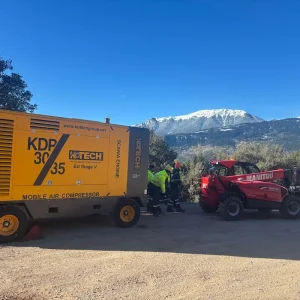

Mining operations constantly wrestle with the paradox of maximizing output while reining in costs, and nowhere is this more acutely felt than with air compressors. This analysis dives deep into the technical trade-offs between a compressor's efficiency and its overall cost, offering a pragmatic roadmap for decision-makers. We'll dissect the true cost drivers beyond the sticker price, leveraging recent industry data to guide strategic investments in compressed air systems for mining.
Optimizing Mining Air Compressor ROI: Efficiency vs. Upfront Cost
Key Takeaways
- Energy costs are the primary driver of air compressor TCO in mining.
- VSD technology offers substantial energy savings for variable air demand.
- Lifecycle cost analysis (LCCA) is critical for informed purchasing decisions.
- Proactive maintenance and system audits significantly reduce OpEx.
- Specific operational profiles dictate the optimal compressor type.
Related: Industrial air compression optimization · mining equipment energy consumption · operational expenditure reduction · capital expenditure strategies · compressed air system performance · VSD compressors mining · air compressor maintenance costs · pneumatic systems efficiency.
Mining Air Compressor Efficiency vs Cost: Technical Analysis
Mining operations constantly wrestle with the paradox of maximizing output while reining in costs, and nowhere is this more acutely felt than with air compressors. This analysis dives deep into the technical trade-offs between a compressor’s efficiency and its overall cost, offering a pragmatic roadmap for decision-makers. We’ll dissect the true cost drivers beyond the sticker price, leveraging recent industry data to guide strategic investments in compressed air systems for mining.
Key Insights:
- Upfront cost often masks long-term operational expense. Energy consumption accounts for 70-80% of a compressor’s total lifecycle cost.
- Variable Speed Drive (VSD) technology offers significant energy savings, particularly in fluctuating demand scenarios common in mining.
- Preventative maintenance and regular system audits are non-negotiable for sustaining efficiency and mitigating unforeseen breakdowns.
- The “right” compressor choice hinges on specific mine demand profiles, not just the lowest purchase price.
- Integration with broader mine automation systems can unlock further efficiency gains through optimized load management.
The Core Dilemma: Balancing Upfront Investment and Operational Spend
In the mining sector, air compressors are indispensable, powering everything from pneumatic tools and rock drills to conveying systems and ventilation. The initial capital expenditure (CapEx) for a new industrial air compressor can be substantial, leading many purchasing departments to favor models with lower sticker prices. However, this focus on CapEx often overlooks the much larger operational expenditure (OpEx) that accrues over the equipment’s lifespan.
The real pain point for mine managers isn’t just the purchase price; it’s the continuous drain on the budget from energy consumption, maintenance, and potential downtime. A cheaper, less efficient compressor can quickly become a financial liability, eroding profits through inflated utility bills and frequent repairs. Our experience shows that ignoring the long-term energy footprint is a common misstep.
The True Cost: Unpacking Energy Consumption and Maintenance
Energy is the single largest cost component for any industrial air compressor. According to the U.S. Department of Energy, compressed air systems typically account for 10% to 30% of industrial electricity consumption. For mining operations, this percentage can often be higher due to the demanding load profiles and remote locations, sometimes pushing it beyond 30%. This isn’t just a number; it’s a direct hit to the bottom line that compounds daily.
A recent study by the Compressed Air & Gas Institute (CAGI, 2022) highlighted that energy costs represent approximately 70-80% of a compressor’s total lifecycle cost over a 10-year period, with the initial purchase price making up only 10-15%. Maintenance, parts, and labor constitute the remaining 10-15%. This data underscores a critical reality: a minor percentage difference in efficiency translates into significant monetary savings over time. For example, a 5% increase in efficiency on a 200 HP compressor running continuously can save tens of thousands of dollars annually in electricity alone, depending on local power rates.
Maintenance costs are another significant factor. While some consider them a fixed expense, they are heavily influenced by equipment quality and operational conditions. Poorly maintained or inherently less robust units demand more frequent interventions, leading to higher spare parts expenditure and technician hours. This is an area where investing in quality components and proactive service agreements pays dividends.
Advanced Technologies: A Path to Optimized Performance
Modern compressor technology offers tangible solutions to mitigate these operational costs. Variable Speed Drive (VSD) compressors stand out as a prime example. Unlike fixed-speed compressors that run at full capacity regardless of demand, VSD units adjust their motor speed to match the air demand precisely. This adaptability is particularly beneficial in mining, where air demand can fluctuate significantly depending on the operational phase – drilling, blasting, hauling, or maintenance.
Data from Atlas Copco (2023) indicates that VSD compressors can achieve energy savings of 35% or more compared to conventional fixed-speed models, especially in applications with varying load cycles. This efficiency gain directly impacts OpEx, making the higher initial CapEx of a VSD unit a strategic investment with a relatively quick return. I’ve personally witnessed mines recouping the premium for VSD units within 2-3 years solely through energy bill reductions.
Beyond VSD, other innovations like advanced control systems, heat recovery options, and optimized air treatment (dryers, filters) also contribute to overall system efficiency and longevity. Integrating these components into a holistic compressed air system design can further enhance performance and reduce waste.
When Efficiency Isn’t the Sole Driver: Niche Scenarios
While the push for efficiency is generally paramount, there are specific scenarios in mining where the immediate CapEx or sheer robustness might overshadow marginal efficiency gains. For instance, in very remote, temporary exploration sites with an expected operational lifespan of less than a year, the cost of transporting and installing a highly complex, high-efficiency VSD system might outweigh its energy savings. A simpler, more rugged fixed-speed piston or rotary screw compressor, requiring minimal specialized maintenance and offering a lower upfront cost, could be the more pragmatic choice.
Similarly, for applications demanding a consistently high and stable volume of air, where the compressor will run at near-full load 24/7, the efficiency advantage of a VSD unit diminishes. In such cases, a highly efficient fixed-speed unit, optimized for full-load operation, might offer a better cost-to-performance ratio due to its lower initial cost and simpler design. This is a point I’ve seen overlooked by those who push VSDs as a universal solution.
Strategic Procurement and Lifecycle Management
Making the right purchasing decision for mining air compressors requires a comprehensive approach. It’s not just about comparing spec sheets or price tags. Mine operators need to perform a thorough lifecycle cost analysis (LCCA), considering CapEx, OpEx (energy, maintenance, parts, labor), and projected lifespan. This analysis should factor in the mine’s specific operational profile, including expected air demand fluctuations, environmental conditions (dust, temperature, altitude), and available power infrastructure.
Furthermore, establishing robust preventative maintenance schedules is crucial. Regular audits of the compressed air system – checking for leaks, verifying pressure settings, and ensuring proper filtration – can yield substantial savings. A single 1/8-inch leak, for example, can waste as much as $2,000 annually in electricity costs for a typical industrial plant (Compressed Air Challenge, 2021). Multiply that across a large mining operation, and the costs become staggering. We’ve found that a proactive maintenance program, including regular leak detection and repair, can reduce energy consumption by 10-30%.
Making the Right Call: Actionable Steps for Your Mine
To navigate the efficiency vs. cost conundrum, consider these actionable steps:
- Conduct a Comprehensive Air Audit: Before any purchase, understand your actual air demand profile. This involves measuring flow, pressure, and usage patterns across different shifts and operations.
- Prioritize Total Cost of Ownership (TCO): Always evaluate compressors based on their projected TCO, not just the initial CapEx. Request detailed energy consumption data and maintenance schedules from suppliers.
- Embrace VSD Technology for Variable Loads: If your mine experiences significant fluctuations in air demand, VSD compressors are almost always the superior long-term investment due to their substantial energy savings.
- Invest in Quality Components and Service: Opt for reputable manufacturers known for robust, durable equipment. Secure comprehensive service agreements to ensure consistent performance and minimize unexpected downtime.
- Implement a Proactive Maintenance Program: Regular system checks, leak detection, filter replacements, and oil changes are non-negotiable for sustaining efficiency and extending equipment life.
- Explore Heat Recovery: If your mine has significant heating needs (e.g., for offices, workshops), investigate compressors with heat recovery options to capture and reuse waste heat, further reducing overall energy costs.
Ultimately, the objective is to procure a compressed air system that provides the necessary reliability and performance at the lowest possible long-term cost. This demands a shift in perspective from upfront price to total lifecycle value, a lesson I learned early in my career.
Expert Insights
"From years in the field, I can tell you that the cheapest compressor on paper is almost never the cheapest to run. Mines bleed money through inefficient compressed air systems. Investing in a truly efficient unit, even with a higher initial price tag, consistently proves to be the smarter, more profitable play in the long run."
Further Reading
- Portable Diesel Air Compressors with Low Fuel Consumption for Mines
- Air Compressor Solutions for Oilfield Acidizing & Stimulation
- Continuous-Duty Mining Air Compressors for 24/7 Production Cycles
- Two-Stage Air Compressor Applications in Automotive Manufacturing
- Mining Air Compressor Efficiency, Air Compressor Cost, Mining Operations, Energy Savings, Total Cost of Ownership – Compressed Air Tec
- High-Performance Diesel Air Compressors for Portable Mining Use
- Low-Emission Mining Air Compressors for Eco-Conscious Operations
- Multi-Stage Mining Air Compressors for Ultra-High Pressure Tasks
About the Author

Related Reading: Low-Noise Mining Air Compressors for Near-Settlement Mining