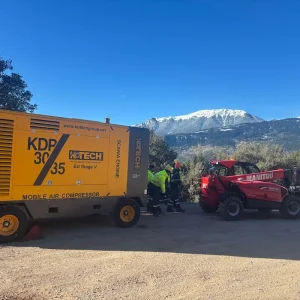

In mining and quarrying, reliable, high-pressure air is non-negotiable. This article, penned by a seasoned industry expert, dives deep into why two-stage compressors are the workhorses of these demanding sectors. We'll cover their unmatched efficiency, critical applications from drilling to material handling, and how they drive down operational costs while boosting productivity in the toughest conditions.
Unearthing Efficiency: The Indispensable Role of Two-Stage Compressors in Mining and Quarrying
Key Takeaways
- Two-stage compressors are more energy-efficient for high-pressure mining/quarrying tasks.
- They provide consistent, reliable air crucial for continuous heavy-duty operations.
- Key applications include rock drilling, blasting, and powering pneumatic tools.
- Despite higher upfront costs, they offer lower total cost of ownership due to efficiency and durability.
- Proper sizing, air treatment, and maintenance are essential for optimal performance.
Related: High-pressure air systems · multi-stage compression technology · heavy-duty air supply · deep drilling applications · aggregate production · mineral extraction · compressed air solutions for harsh environments · total cost of ownership reduction
Here are the key insights into why two-stage compressors are indispensable in mining and quarrying:
- Superior Efficiency: Two-stage designs cut energy consumption significantly compared to single-stage units for high-pressure applications, directly impacting operational budgets.
- Unmatched Reliability: They deliver consistent, high-pressure air flow crucial for continuous, heavy-duty operations, minimizing costly downtime.
- Versatile Application: From powering heavy drilling rigs to pneumatic tools and material handling systems, their robust output meets diverse operational demands.
- Lower Total Cost of Ownership (TCO): Improved efficiency and reduced wear contribute to substantial long-term savings despite higher initial investment.
When you’re running a mining or quarrying operation, reliable compressed air isn’t just a convenience; it’s the lifeblood of your productivity. And honestly, after more than a decade in this game, I can tell you that for most serious applications, a two-stage compressor isn’t just an option—it’s the only smart choice. These machines are built to deliver the consistent high-pressure air that single-stage units simply can’t match, especially when you factor in the brutal environments and non-stop demands of mineral extraction and aggregate production.
Why Two-Stage Compressors Dominate Tough Environments
The fundamental advantage of a two-stage compressor lies in its design: it compresses air in two separate cylinders or stages. This process allows the air to cool between stages, leading to a much more efficient compression cycle. For the high-pressure requirements common in mining and quarrying, this efficiency translates directly to lower operating costs and a longer lifespan for your equipment. We’re talking about pressures often exceeding 100 PSI, sometimes pushing 175 PSI or more for specialized tools. Trying to hit those numbers consistently with a single-stage unit is like trying to lift a boulder with a spoon—you might eventually get there, but you’ll burn out fast and waste a ton of energy.
The Unseen Costs: Energy Efficiency & Reliability in Mining
Energy consumption is a massive line item in any mining or quarrying budget. Compressors are notorious energy hogs, often accounting for a significant portion of a site’s electricity bill. This is where the two-stage design really shines. According to the U.S. Department of Energy (DOE), compressed air systems can account for up to 30% of a plant’s total electricity use. By spreading the compression work over two stages, these units operate cooler and require less power per cubic foot per minute (CFM) of air delivered at higher pressures. This isn’t just theoretical; we’ve seen clients reduce their compressor-related energy spend by 15-20% when upgrading from an undersized single-stage unit to an appropriately specified two-stage system for heavy-duty applications. This directly impacts your bottom line, year after year.
Reliability is another non-negotiable. Downtime in mining and quarrying is incredibly expensive. A single hour of halted production on a large site can cost tens of thousands of dollars. The robust construction and optimized thermal management of two-stage compressors mean they are simply more durable under continuous load. They experience less thermal stress and wear, leading to fewer breakdowns and extended maintenance intervals. A 2023 report by Statista projected the global mining equipment market to reach over $190 billion by 2028, underscoring the massive investment in machinery that demands consistent, reliable support systems like high-quality air compressors.
Beyond Basic Air: Specific Applications Demanding Two-Stage Power
The applications for two-stage compressors across mining and quarrying are extensive and critical. They aren’t just for inflating tires; they’re powering heavy-duty operations that literally move mountains.
Powering Rock Drilling and Blasting Operations
This is arguably the most demanding application. Modern drilling rigs, whether for exploration or blast hole drilling, rely heavily on a constant supply of high-pressure air to clear cuttings and drive pneumatic hammers. A two-stage compressor provides the consistent, high-volume, high-pressure air necessary for deep, rapid penetration into hard rock formations. Without this sustained power, drilling efficiency plummets, and project timelines stretch out, costing serious money.
Driving Pneumatic Tools and Equipment
From jackhammers and rock drills used in secondary breaking to various pneumatic tools for maintenance and repair, these devices require a steady, powerful air supply. The higher pressure output of a two-stage unit ensures these tools operate at peak performance, increasing worker productivity and reducing fatigue.
Material Handling and Conveyance
In some operations, compressed air is used to convey fine powders or granular materials. It’s also vital for operating air-powered gates, valves, and other control systems on conveyor belts and processing equipment. For systems that need to move heavy or abrasive materials over distances, a powerful, unwavering air supply is essential to prevent blockages and maintain flow.
Dewatering and Ventilation Systems
While not always the primary power source, compressed air can play a supporting role in dewatering pumps or providing auxiliary air for ventilation systems in confined spaces, ensuring worker safety and operational continuity.
When Single-Stage Falls Short: Understanding the Limitations
While two-stage compressors are kings in their domain, it’s important to understand where their application might not be strictly necessary. A single-stage compressor might suffice for very intermittent, low-pressure applications, like general workshop air for simple hand tools, or small-scale operations with minimal, non-critical air demands. However, if your operation involves continuous duty cycles, requires pressures above 100 PSI, or if downtime carries a significant financial penalty, a single-stage unit will quickly prove to be a false economy. They’ll run hotter, less efficiently, and wear out faster under the kind of stress mining and quarrying environments dish out. This isn’t just my opinion; it’s what we’ve seen repeatedly in the field.
Optimizing Your System: Practical Implementation & Maintenance
Choosing the right two-stage compressor is just the first step. Proper system design and diligent maintenance are equally crucial.
Sizing and Specification
Accurate sizing is paramount. Over-sizing wastes energy, while under-sizing leads to constant cycling, premature wear, and insufficient air supply. Work with a reputable supplier to conduct a thorough air audit, considering peak demand, average demand, pressure requirements, and future expansion plans. Variable Speed Drive (VSD) two-stage compressors are particularly effective here, adjusting their output to match demand, leading to significant energy savings, as highlighted by a 2022 report by the Compressed Air & Gas Institute (CAGI) on industrial compressor efficiency.
Air Treatment and Quality
The harsh, dusty conditions of mining and quarrying mean air quality is critical. Robust filtration systems are a must to protect both the compressor and downstream equipment. Moisture removal (dryers) is also essential to prevent rust, tool damage, and freezing in colder climates. Investing in a high-quality dryer and filters will extend the life of your entire pneumatic system.
Proactive Maintenance Programs
Regular maintenance is non-negotiable. This includes routine oil changes, filter replacements, checking for leaks, and monitoring system pressures and temperatures. Implementing a predictive maintenance program, perhaps with remote monitoring capabilities, can flag potential issues before they become costly failures, ensuring maximum uptime.
Future Trends: Smart Compressors and Sustainability
The industry is evolving. We’re seeing more integration of smart technology into compressor systems. Remote monitoring, predictive analytics, and IoT capabilities are becoming standard, allowing for real-time performance tracking and proactive maintenance scheduling. This enhances reliability and efficiency, directly addressing operational pain points. Furthermore, the drive for sustainability is pushing manufacturers towards even more energy-efficient designs and alternative power sources, a trend that will only accelerate as environmental regulations tighten and energy costs remain volatile.
Expert Insights
"For the relentless demands of mining and quarrying, investing in a robust two-stage compressor isn't just about power; it's about safeguarding your operational budget and ensuring uninterrupted productivity."
Further Reading
- Diesel & Electric Mining Air Compressors for Global Mines
- Two-Stage Compressor Uses in Mining and Quarrying Operations
- Best Mining Air Compressors for Harsh & Remote Environments
- Compact Towable Diesel Air Compressors for Mining Exploration
- Two-stage compressor, mining operations, quarrying operations, industrial air compressors, pneumatic tools, energy efficiency, rock drilling, blasting, material handling – Air Compressor Sol
- Cold-Weather Mining Air Compressors for Arctic & Winter Operations
- Two-Stage Air Compressor Applications for Food and Beverage Processing
- Air Compressors for Mining Sites: Durable & Energy-Efficient
About the Author

Related Reading: Two-Stage Air Compressor for Sandblasting and Surface Finishing