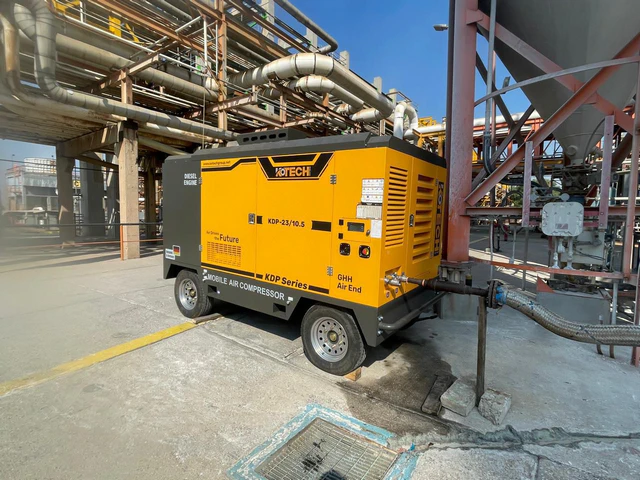
Mastering Air Compressor Deployment in Onshore Oilfields
They’re not just a piece of auxiliary equipment; they’re the lungs of many operations, often determining whether a project stays on schedule and budget. Forget the flashier pieces of kit; without reliable air, a lot of what we do simply grinds to a halt. The core conclusion here is simple: understanding and optimizing your air compressor strategy isn’t optional; it’s fundamental to operational success and profitability in the oil patch.
The Critical Role of Air Compressors: Beyond Just Power
Air compressors in onshore oilfields are far more than simple power sources. They are integral to pneumatic systems that drive everything from heavy-duty drilling equipment to delicate process controls. The operational environment—often remote, dusty, and subject to extreme temperatures—demands equipment that can withstand severe conditions while maintaining peak performance. Reliability is not a luxury; it’s an absolute necessity. A compressor failure can cascade into significant delays, personnel safety risks, and substantial financial losses, easily running into hundreds of thousands of dollars daily for critical operations like drilling.
The sheer variety of tasks performed by these machines is astonishing. From providing high-pressure air for downhole tools to supplying instrument air that ensures precise valve actuation, the demands vary wildly.
Key Onshore Applications: Where Air Power Matters
Onshore oilfield operations present a spectrum of applications, each with unique demands for compressed air:
Drilling & Well Servicing
This is perhaps the most visible application. Drilling rigs rely heavily on compressed air for a multitude of functions: operating pneumatic tools, powering mud pumps, actuating rig slips, and even for air drilling in certain formations. High-pressure, high-volume compressors are typically required here, often mounted on skids or trailers for mobility. During well servicing, air is used for tasks like cleaning wells, operating fracturing equipment, and powering various maintenance tools.
Instrument Air & Process Control
In production facilities and processing plants, instrument air is indispensable. It’s clean, dry, and oil-free air used to operate pneumatic instruments, valves, actuators, and control systems. The purity and consistent pressure of instrument air are paramount to prevent corrosion, freezing, or malfunction of sensitive equipment. Any contamination can lead to inaccurate readings or complete system shutdowns, jeopardizing process safety and efficiency.
Enhanced Oil Recovery (EOR) & Gas Lift
For mature fields, EOR techniques are vital. Air compressors can be used in some EOR methods, though more commonly, natural gas or CO2 injection is employed. However, in gas lift operations, compressed air or gas is injected into the wellbore to lighten the fluid column, allowing the reservoir pressure to push oil to the surface. This requires robust, high-pressure compressors capable of continuous operation under varying load conditions. The integrity of the air stream is crucial to avoid plugging downhole equipment.
Utility & Maintenance Air
Across the entire onshore footprint, utility air is needed for general shop tasks, powering hand tools, sandblasting, painting, and general equipment maintenance. These are typically smaller, more versatile compressors, often portable, that can be moved between different work sites as needed. While less critical than instrument air, their availability directly impacts maintenance efficiency and overall site productivity.
Navigating Operational Challenges & Cost Drivers
Operating air compressors in onshore oilfields comes with significant challenges. The remote nature of many sites means limited access to power grids, often necessitating diesel-driven units that come with their own fuel, maintenance, and emissions considerations. Environmental factors like extreme heat, freezing temperatures, dust, and corrosive gases can severely impact equipment lifespan and performance. Dust, for instance, is a notorious culprit for prematurely clogging filters and wearing out internal components.
Maintenance in these conditions is a major pain point. Getting skilled technicians and spare parts to a remote location can be time-consuming and expensive. This makes predictive maintenance strategies, enabled by advanced monitoring systems, increasingly valuable. Furthermore, energy consumption is a huge cost driver. Compressors are inherently energy-intensive, and even small inefficiencies can add up to staggering operational expenses over time. This is where the push for more efficient designs and smarter control systems truly pays off.
The Drive for Efficiency and Reliability: Industry Trends & Data
The industry’s focus has sharpened on maximizing uptime and reducing operational expenditures, especially given fluctuating commodity prices. This has fueled significant advancements in compressor technology and operational strategies.
Firstly, the adoption of variable speed drive (VSD) compressors is gaining traction. These units can adjust their motor speed to match air demand, leading to substantial energy savings compared to fixed-speed compressors that run constantly at full power. A 2023 report by Grand View Research projected the global industrial air compressor market to grow significantly, driven by efficiency demands, with VSD technology playing a key role in energy-intensive sectors like oil & gas.
Secondly, remote monitoring and predictive maintenance are no longer niche technologies. This allows operators to identify potential failures before they occur, scheduling maintenance proactively rather than reactively, which dramatically reduces unplanned downtime.
Lastly, there’s a growing trend towards electrification where feasible. While diesel remains dominant for mobile applications, fixed-site installations are increasingly moving towards electric-driven compressors, especially as grid infrastructure expands or renewable energy sources become more integrated. This reduces local emissions, lowers fuel costs, and often simplifies maintenance. A 2024 report from Wood Mackenzie highlighted that environmental regulations and corporate sustainability targets are accelerating the shift towards lower-emission solutions across the energy sector, directly impacting compressor selection.
Selecting the Right Compressor: A Strategic Imperative
Choosing the correct air compressor for an onshore oilfield application is a strategic decision that impacts everything from capital expenditure to operational efficiency and environmental compliance. It’s not just about horsepower; it’s about understanding the specific demands of the task.
- Capacity & Pressure: Accurately sizing the compressor to the required airflow (CFM) and pressure (PSI) is critical. Oversizing wastes energy, while undersizing leads to insufficient power and potential equipment damage.
- Type of Compressor: Rotary screw compressors are common for continuous, high-volume applications, while reciprocating (piston) compressors might be better suited for high-pressure, intermittent demands. Oil-free compressors are essential for instrument air applications to prevent contamination.
- Portability vs. Fixed Installation: Mobile, skid-mounted, or trailer-mounted units offer flexibility for drilling and well servicing. Fixed installations are more common for long-term production facilities.
- Drive System: Diesel-driven units offer independence from grid power, but electric units provide lower operating costs and emissions where power is available. Hybrid options are also emerging.
- Environmental Considerations: Noise levels, emissions, and waste heat recovery can all influence selection, especially with tightening environmental regulations.
The Future of Onshore Air Compression: Automation & Sustainability
The trajectory for air compressors in onshore oil and gas is clear: smarter, cleaner, and more integrated. Expect to see greater emphasis on fully autonomous compressor systems that can self-regulate, diagnose issues, and even communicate with other field equipment. The push for sustainability will continue to drive innovations in energy efficiency, waste heat recovery, and the integration of alternative power sources. While the upfront investment in advanced systems might be higher, the long-term benefits in terms of reduced downtime, lower operating costs, and improved environmental performance make them an increasingly attractive proposition. This is where competitive advantage will be found.
When Conventional Wisdom Fails: Boundary Conditions
While efficiency and advanced technology are often the best path forward, it’s important to recognize that not every solution fits every scenario. For instance, a highly sophisticated VSD electric compressor with extensive IIoT integration might be overkill—and financially impractical—for a temporary, low-demand utility air application in an extremely remote, off-grid location. In such cases, a simpler, robust, diesel-driven portable unit, perhaps even a well-maintained older model, might be the more pragmatic and cost-effective choice. The “best” solution isn’t always the most technologically advanced; it’s the one that best meets the specific operational, environmental, and budgetary constraints of a given project. You’ve got to be honest about the real-world conditions, not just what the sales brochure promises.