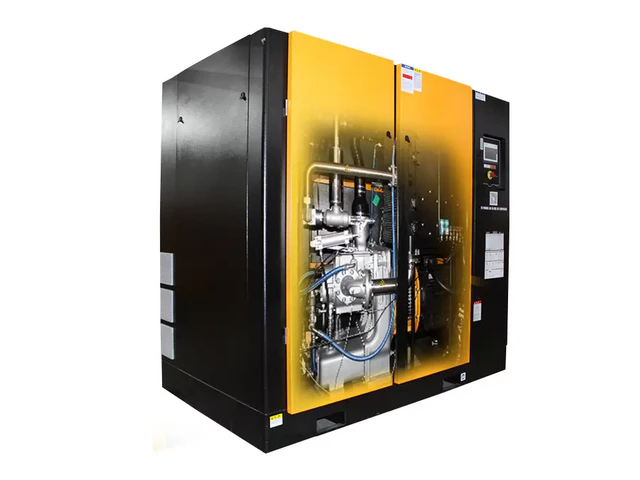
Power and Precision: Why Blasting and Demolition Demand Two-Stage Air Compressors
- **Two-stage compressors are non-negotiable for continuous blasting and heavy demolition; single-stage units overheat, drop pressure, and cause rapid tool failure under sustained load.**
- **Moisture control is the critical failure point; integrating an aftercooler and water separator is mandatory to prevent blasting media clogs and internal tool corrosion.**
—
The Brutal Reality of Demolition and Blasting Air Demands
If you are running a 90-pound pneumatic breaker or a continuous sandblasting nozzle on a single-stage compressor, you are bleeding money. The result is always the same: tools stall, crews stand around waiting for pressure to build, and the compressor pump burns out prematurely.
Demolition and blasting tools do not run on intermittent air. They are high-consumption, continuous-duty machines. To keep them running at peak impact energy or abrasive velocity, you need a system that delivers high volume (CFM) at high, sustained pressure (PSI) without breaking a sweat. This is where the two-stage air compressor becomes the backbone of your operation.
On these rugged job sites, single-stage units simply cannot keep pace with the duty cycles required by modern pneumatic equipment.
—
How Two-Stage Compression Solves the Heat and Pressure Problem
To understand why a two-stage compressor is essential for these applications, you have to look at the physics of air compression. When you compress air, you generate heat.
In a single-stage compressor, air is drawn into a cylinder, compressed to its final pressure (typically 90 to 125 PSI) in a single stroke, and pushed into the receiver tank. This process generates extreme heat. High heat reduces air density, lowers volumetric efficiency, and accelerates the breakdown of lubricating oil. If you try to run a continuous-duty tool like a rock drill on this setup, the pump will run constantly, overheat, and eventually seize.
A two-stage compressor handles this work in two distinct phases:
1. **First Stage (Low Pressure):** Air is drawn into a large cylinder and compressed to approximately 50 to 70 PSI. 2. **Intercooling:** The partially compressed air travels through an intercooler—usually a series of finned copper tubes cooled by the compressor’s flywheel fan. This drops the air temperature significantly. 3. **Second Stage (High Pressure):** The cooled, denser air enters a smaller cylinder where it is compressed to its final pressure, typically between 145 and 175 PSI.
“` [Ambient Air] │ ▼ ┌──────────────┐ │ First Stage │ ──► (Generates heat, compresses to ~60 PSI) └──────────────┘ │ ▼ ┌──────────────┐ │ Intercooler │ ──► (Finned tubes cool the air, increasing density) └──────────────┘ │ ▼ ┌──────────────┐ │ Second Stage │ ──► (Compresses dense air to final 175 PSI) └──────────────┘ │ ▼ [Receiver Tank] “`
Because the air is cooled between stages, the second-stage piston does not have to work as hard to achieve high pressure. This intercooling process is highly efficient. For a demolition crew running multiple tools, that efficiency translates directly into lower fuel consumption and less wear on the compressor engine or motor.
—
Matching Compressor Output to Demolition and Blasting Tools
You cannot guess your CFM and PSI requirements on a commercial job site. If you under-size your compressor, your tools will lack the power to break high-strength concrete or strip industrial coatings.
Different tools have wildly different consumption profiles. Let’s look at the real-world requirements for common demolition and blasting equipment:
| Tool Type | Operating Pressure (PSI) | Air Consumption (CFM) | Recommended Compressor Type |
|---|---|---|---|
| **Medium Rock Drill** | 90 – 100 | 80 – 100 | Two-Stage (Gas/Diesel Portable) |
| **90-lb Paving Breaker** | 90 – 100 | 75 – 85 | Two-Stage (Gas/Diesel Portable) |
| **#4 Blasting Nozzle (1/4″)** | 100 | 81 | Two-Stage (Stationary or Portable) |
| **#6 Blasting Nozzle (3/8″)** | 100 | 220 | High-Capacity Rotary Screw / Two-Stage |
| **Pneumatic Scabbler** | 90 | 30 – 45 | Two-Stage (Small Portable) |
|:— |:— |:— |:— | | **Medium Rock Drill** | 90 – 100 | 80 – 100 | Two-Stage (Gas/Diesel Portable) | | **90-lb Paving Breaker** | 90 – 100 | 75 – 85 | Two-Stage (Gas/Diesel Portable) | | **#4 Blasting Nozzle (1/4″)**| 100 | 81 | Two-Stage (Stationary or Portable) | | **#6 Blasting Nozzle (3/8″)**| 100 | 220 | High-Capacity Rotary Screw / Two-Stage | | **Pneumatic Scabbler** | 90 | 30 – 45 | Two-Stage (Small Portable) |
Granted, a single-stage compressor might claim to hit 135 PSI, but it cannot maintain the required CFM at that pressure for more than a few minutes before its duty cycle is exceeded. You must build in a safety margin.
If you are running a 90-lb breaker that consumes 80 CFM, your compressor should deliver at least 104 CFM at 100 PSI. This prevents the compressor from running at its absolute limit, reducing heat buildup and extending the life of the pump.
—
The Critical Role of Pressure in Abrasive Blasting
In abrasive blasting, pressure is productivity. Many operators believe that as long as media is coming out of the nozzle, the system is working fine. This is a costly misconception.
A two-stage compressor provides the high-pressure reservoir (typically 175 PSI in the tank) needed to absorb the sudden pressure drops that occur when a blasting nozzle is opened. By regulating down from a high-pressure tank to a steady 100-110 PSI at the nozzle, you guarantee a consistent velocity that keeps the abrasive media fracturing correctly against the substrate.
—
Moisture Control: The Silent Killer of Demolition Systems
Compressing air squeezes water out of it. When hot, compressed air cools down in your lines, water vapor condenses into liquid. In mining and demolition, water in your air lines is catastrophic.
For abrasive blasting, moisture causes the blasting media (such as garnet, coal slag, or glass bead) to damp and clump inside the blast pot. This clogs the metering valve, stalls the flow, and requires you to blow out the system—a process that can waste hours of labor.
For pneumatic demolition tools like jackhammers and rock drills, moisture washes away the internal lubricants. This leads to metal-on-metal friction, rapid piston wear, and eventual tool seizure. In cold weather, that moisture freezes inside the exhaust ports of your tools, causing them to ice up and lose power.
To prevent this, a professional two-stage system must include:
1. **Air-Cooled Aftercooler:** This lowers the temperature of the discharged air to within 15°F of the ambient temperature, forcing the moisture to condense before it enters the air lines. 3. **Coalescing and Desiccant Filters:** For blasting operations, a final desiccant dryer is highly recommended to lower the dew point of the air, ensuring dry media flow even in humid environments.
—
Key Design Features for Harsh Mining and Demolition Environments
Mining pits and demolition sites are dusty, dirty, and physically demanding. A standard workshop compressor will not survive here. When selecting a two-stage compressor for these environments, look for these specific engineering features:
- **Cast-Iron Pump Construction:** Aluminum pumps with cast-iron sleeves are fine for light automotive work, but they cannot handle the thermal stress of continuous demolition work. Solid cast-iron cylinders, heads, and crankcases offer superior heat dissipation and structural rigidity.
- **Pressure Lubrication:** Splash lubrication is common in smaller units, but pressure lubrication uses an oil pump to deliver continuous oil flow to critical bearings. This is vital if you are operating the compressor on uneven ground or slopes, which is common in mining and excavation.
- **Oversized Air Intake Filters:** Demolition sites are thick with concrete dust and silica. A small, paper-element filter will clog in hours, starving the compressor of air and pulling dust into the cylinders. Look for heavy-duty, multi-stage canister filters with replaceable elements.
- **Low-Oil Shutdown:** On busy job sites, daily maintenance can be overlooked. A low-oil shutdown switch prevents the engine or motor from running if oil levels drop, saving you from a catastrophic pump failure.
—
Maximizing ROI: Fuel and Maintenance Strategies
A high-quality two-stage compressor is a significant investment. To ensure you get a rapid return on that investment, you must implement a strict preventative maintenance schedule.
First, monitor your oil. The high operating temperatures of continuous blasting can cause standard mineral oils to oxidize quickly. Synthetics maintain their viscosity at high temperatures, reduce carbon buildup on the reed valves, and can extend your oil change intervals from 500 hours to over 2,000 hours.
Second, check your drive belts weekly. A loose belt slips, reducing pump RPM and lowering your CFM output. It also generates friction heat that can damage the pump bearings and engine shaft. Keep belts tensioned to the manufacturer’s exact specifications.
Finally, daily tank draining is non-negotiable. If you do not drain the accumulated water from your receiver tank daily, you reduce the storage capacity of the tank, causing the compressor to cycle more frequently. Installing an automatic electronic drain valve ensures this critical step is never missed, protecting both your tank from internal corrosion and your tools from water damage.