Mastering Large-Scale Mining Air Compressor Systems
Designing and configuring a large-scale mining air compressor system is a high-stakes game. Get it wrong, and you’re looking at crippling downtime, soaring operational costs, and compromised safety. The core truth? Success hinges on a deep understanding of your mine’s unique demands, not just raw horsepower. We’re talking about a holistic approach that prioritizes reliability, energy efficiency, and long-term total cost of ownership (TCO).
- Strategic TCO Focus: Prioritize lifetime operational costs over initial capital expenditure for sustainable mine site air supply.
- Robust System Reliability: Engineer for extreme conditions to guarantee uptime, a critical factor given remote mining locations.
- Energy Efficiency Mandate: Implement Variable Speed Drive (VSD) technology and optimized piping to slash power consumption, often a major expense.
- Modular & Scalable Design: Build systems that can adapt to evolving mine plans and production demands without costly overhauls.
The Imperative for Optimized Mine Air Systems: A Conclusion
In large-scale mining, compressed air isn’t a luxury; it’s the lifeblood for everything from drilling and blasting to ventilation and pneumatic tools. The critical conclusion is this: an optimized air compressor system is non-negotiable for operational continuity and profitability. Failing to invest in proper design and configuration from the outset will inevitably lead to compounding problems down the line, eroding margins and jeopardizing production targets.
The stakes are incredibly high. Remote locations mean maintenance is costly and slow. Harsh environments accelerate wear and tear. Therefore, the design must anticipate these challenges, integrating robust components and smart monitoring to prevent failures before they happen. This proactive stance isn’t just good practice; it’s essential for survival in a competitive market.
Data-Driven Insights: Trends & Financial Impact
The mining sector is under constant pressure to improve efficiency and reduce environmental impact. This directly influences air compressor system choices.
Energy Consumption & Efficiency Gains
Compressed air systems are notorious energy hogs. In remote mining operations, where power often comes from expensive diesel generators, this percentage can be even higher. This figure underscores the immediate financial impact of inefficient systems.
However, there’s a silver lining. The adoption of Variable Speed Drive (VSD) compressors is rapidly increasing.
The Cost of Downtime
Beyond energy, reliability is king. Unscheduled downtime in large-scale mining operations carries a staggering price tag. This makes the upfront investment in a robust, well-designed air system a clear economic imperative, not just an operational one.
These figures aren’t just abstract numbers; they represent tangible risks to your bottom line. Investing in predictive maintenance technologies and high-quality, mine-spec components is a direct hedge against these financial losses.
Reasoning Behind Robust Design Choices: Why It Matters
The rationale for meticulous design in large-scale mining air compressor systems boils down to several interconnected factors:
Harsh Operating Environments
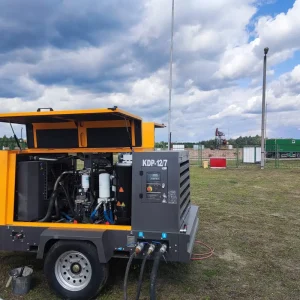
Mines are not factories. They are often located in extreme climates—think scorching deserts, freezing tundras, or high altitudes. Dust, moisture, and corrosive elements are constant threats. Portable diesel air compressors, while offering flexibility, must be engineered to withstand these conditions. This means heavy-duty enclosures, superior filtration systems, and components rated for wide temperature swings. Standard industrial compressors simply won’t cut it for long.
Remote Locations & Logistics
Many large-scale mines are in remote areas, far from urban centers and specialized service providers. This logistical challenge makes reliable equipment paramount. Every breakdown means costly delays for parts and technicians. Moreover, the lack of a stable grid often necessitates portable diesel compressors, which require careful fuel management and robust genset integration.
Safety & Compliance
Compressed air systems must meet stringent safety standards. Improperly designed or maintained systems pose explosion risks, can lead to equipment failure, and compromise air quality for personnel. Compliance with local regulations and international standards (e.g., ISO 8573 for air quality) isn’t optional; it’s a legal and ethical requirement, especially when air is used for breathing apparatus or sensitive process controls.
Boundary Conditions: When Advanced Solutions Aren’t the Perfect Fit
There are specific scenarios where their implementation might not be the most cost-effective or practical solution. For instance, for very short-term exploration projects (e.g., less than 6 months) requiring minimal air volume and where initial capital outlay is severely restricted, a standard fixed-speed diesel compressor might be adequate.
Similarly, for truly intermittent, low-demand applications, the higher upfront cost and complexity of a VSD unit might not yield sufficient ROI over its operational lifespan. In these niche cases, a simpler, more robust fixed-speed unit, perhaps even a refurbished one, could offer better value, provided maintenance schedules are rigorously adhered to. It’s a balance between CAPEX and OPEX, and sometimes, for truly temporary setups, the scale tips towards lower initial investment.
Practical Implementation: Design & Configuration Strategies
Executing a successful large-scale mining air compressor system design involves several key practical steps. This isn’t just theory; it’s about getting hands-on with the details.
Accurate Air Demand Assessment
Before any equipment is specified, conduct a thorough air audit. This involves measuring current air consumption patterns, identifying peak demands, and forecasting future needs based on mine expansion plans. Over-sizing leads to wasted energy and higher CAPEX; under-sizing causes pressure drops and productivity losses. This step is foundational for selecting the right number and size of portable diesel compressors.
Component Selection & Redundancy
Opt for mine-spec components. This includes heavy-duty air ends, robust cooling systems, and corrosion-resistant materials. Implement N+1 or N+2 redundancy for critical applications. If one compressor fails, another must seamlessly take over to prevent operational halts. This often means running multiple smaller portable diesel units in parallel rather than one massive one.
- Compressor Type: For portable diesel applications, consider rotary screw compressors due to their continuous duty cycle and robust nature.
- Filtration: Multi-stage filtration is essential to protect equipment from dust and provide clean air for tools and processes.
- Air Treatment: Depending on the application, consider aftercoolers, moisture separators, and air dryers to prevent condensation and corrosion in downstream equipment.
Piping & Distribution Network Design
The piping network is as crucial as the compressors themselves. Design for minimal pressure drop using appropriately sized pipes and smooth bends. Use durable, corrosion-resistant materials. A poorly designed network can negate all the efficiency gains from high-performance compressors. Ensure quick-connect fittings are robust and leak-proof for portable setups.
Remote Monitoring & Predictive Maintenance
Integrate SCADA systems or specialized compressor management software for remote monitoring. This allows operators to track performance metrics (pressure, temperature, flow, fuel levels for diesel units) from a central control room. Predictive maintenance, utilizing sensors and data analytics, can flag potential issues before they escalate into costly failures.
Electrification & Hybrid Solutions
While portable diesel compressors are common, the industry trend is towards electrification. Explore hybrid solutions that combine diesel power with grid or renewable energy sources where available. This can significantly reduce fuel consumption, emissions, and noise pollution. Some modern portable units are designed for easy transition between diesel and electric power, offering flexibility as mine infrastructure evolves.