Two-Stage Air Compressor Benefits for Modern Woodworking
For any woodworking professional running a shop that relies heavily on pneumatic tools and machinery, the question isn’t *if* you need a robust air compressor, but *what kind* of compressor truly delivers. A two-stage air compressor isn’t just a luxury; it’s a non-negotiable asset for modern woodworking, providing the consistent pressure and volume that single-stage units simply can’t match under continuous load. This directly impacts everything from tool longevity to the quality of your finish work and, critically, your bottom line through energy savings.
Why Two-Stage Compressors Are Essential for Woodworking Success
The core issue many woodworkers face is inconsistent air supply. A single-stage compressor, while cheaper upfront, often struggles to maintain the required CFM (Cubic Feet per Minute) and PSI (Pounds per Square Inch) for tools like orbital sanders, CNC machinery, or high-volume low-pressure (HVLP) spray guns, especially during prolonged use. This leads to frustrating slowdowns, uneven finishes, and premature tool wear. Two-stage compressors solve this by compressing air in two steps, resulting in higher efficiency, lower operating temperatures, and a more consistent, higher-pressure output.
Upgrading to a two-stage system often feels like unlocking a new level of productivity.
The Clear Performance Edge: Data & Dollars
The performance benefits of two-stage compressors translate directly into tangible savings and improved operational efficiency.
One major factor is energy consumption. Compressed air systems are notorious energy hogs, often accounting for a significant portion of a facility’s electricity bill. Two-stage compressors, by design, are inherently more energy-efficient than single-stage units for applications requiring higher pressures (above 100 PSI) because they distribute the compression work over two cylinders, reducing the heat generated and the energy required per CFM. This means lower utility bills every month.
CNC machines, for instance, demand not just volume but consistent pressure for precise tool changes and dust extraction. A two-stage unit ensures these critical operations run flawlessly.
Finally, tool longevity is a huge deal. When pneumatic tools operate with insufficient or fluctuating pressure, they work harder, generate more heat, and wear out faster. Consistent air from a two-stage system protects your investment in routers, sanders, nail guns, and finishing equipment, reducing replacement costs and downtime.
Technical Reasoning: Why Two Stages Beat One
The mechanics behind a two-stage compressor are straightforward but impactful. Air is drawn into a first-stage cylinder, partially compressed, then cooled and transferred to a smaller, second-stage cylinder where it’s compressed to its final pressure. This intercooling between stages is key; it reduces the air temperature, which in turn reduces the energy required for the second compression. Hotter air is less dense, meaning more energy is needed to compress it to a given pressure. Cooler air means more CFM per horsepower (HP) and less moisture in the tank.
This process also results in less strain on the compressor’s components, leading to a longer operational life for the unit itself. For woodworking environments, which can be dusty and demanding, this added durability is invaluable.
When a Two-Stage Might Not Be Your First Pick
While two-stage compressors offer significant advantages, they aren’t always the *only* solution, or even the *best* solution, for every single woodworking scenario. For a very small hobbyist shop with minimal, intermittent pneumatic tool usage – think a single brad nailer or a small airbrush for touch-ups – the higher upfront cost and larger footprint of a two-stage unit might be overkill. In such cases, a well-maintained, high-quality single-stage compressor with an adequately sized tank could suffice.
However, as soon as you introduce continuous use tools like orbital sanders, dust collection systems, or any form of CNC machinery, the efficiency and consistency argument for a two-stage system quickly outweighs the initial cost difference. The boundary condition here is sustained demand; if your tools are running for more than a few minutes at a time, or if you’re running multiple tools concurrently, you’re crossing into two-stage territory.
Practical Implementation: Sizing, Air Quality, and Maintenance
Implementing a two-stage air compressor system in a woodworking shop involves more than just plugging it in.
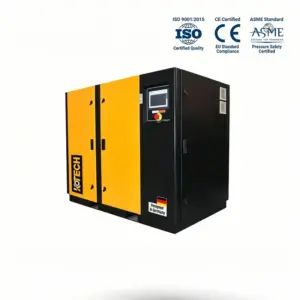
1. **Sizing is Critical:** Don’t guess. A common mistake is buying a compressor based purely on HP, rather than the actual CFM output at the required PSI. 2. **Air Quality Matters:** Woodworking often involves finishing. Moisture and oil in your compressed air can ruin a paint job or cause pneumatic tools to seize. Invest in a good air dryer (refrigerated or desiccant) and inline filters (particulate and coalescing). This is non-negotiable for high-quality finishing applications. 3. Location and Noise: Two-stage piston compressors can be noisy. Consider placing the unit in a separate compressor room or an enclosure to minimize shop noise. Rotary screw compressors, while often more expensive, are generally quieter and designed for continuous, heavy-duty operation, making them a strong consideration for larger industrial woodworking facilities. 4. **Regular Maintenance:** Just like any piece of critical machinery, regular maintenance is key. This includes draining the tank daily to prevent rust and moisture buildup, checking and changing air filters, and monitoring oil levels. A neglected compressor is a costly compressor.
Based on our experience, shops that proactively size their systems correctly and prioritize air quality and maintenance see the fastest ROI and the fewest headaches.
Conclusion: A Foundation for Professional Woodworking
For any professional woodworking operation aiming for efficiency, precision, and longevity from its tools and machinery, the two-stage air compressor is the clear choice. It’s an investment that pays dividends in consistent performance, reduced energy costs, extended tool life, and ultimately, higher quality output. Don’t let a bottleneck in your air supply limit your shop’s potential.