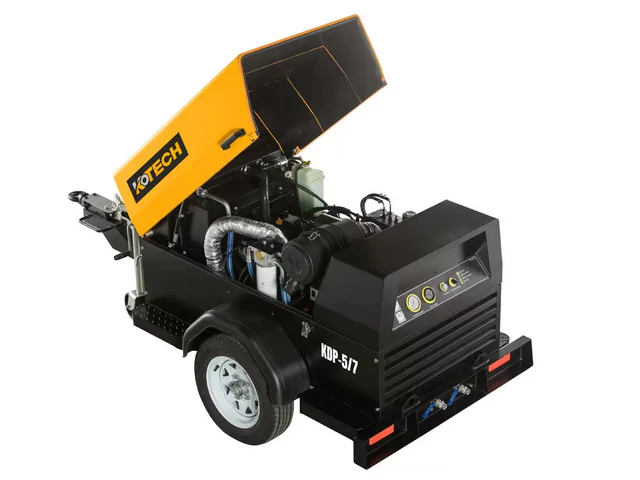
Unlocking Uninterrupted Performance: The Two-Stage Advantage
Why Two-Stage Compressors Dominate Continuous Industrial Operations
When we talk about industrial applications, especially those in mining or heavy manufacturing, “continuous duty” isn’t just a marketing buzzword. It means 24/7 operation, often in harsh environments, where compressed air is the lifeblood of production. In these scenarios, an industrial two-stage compressor isn’t merely a preference; it’s the only viable solution for maintaining consistent output and ensuring system longevity. Single-stage compressors, while suitable for intermittent use, simply cannot handle the sustained thermal and mechanical stresses of non-stop operation without frequent breakdowns and substantial efficiency losses. This choice directly impacts your bottom line, influencing everything from production rates to maintenance budgets.
The Unseen Costs of Downtime: Data-Driven Insights
The true cost of a compressor failure extends far beyond repair bills. Unplanned downtime can cascade through an entire production line, leading to missed deadlines, lost revenue, and even safety hazards. Investing in a two-stage compressor is a proactive step to safeguard against such catastrophic losses.
Beyond reliability, energy consumption is another colossal expense. Compressed air systems are notorious energy hogs, often accounting for a significant portion of an industrial plant’s electricity bill. Two-stage compressors inherently offer better energy efficiency compared to their single-stage counterparts operating at similar pressures. By splitting the compression into two phases with intercooling, they reduce the heat generated per stage, leading to less energy waste.
Engineering for Endurance: How Two-Stage Design Delivers
The fundamental advantage of an industrial two-stage compressor lies in its design. Instead of compressing air from atmospheric pressure to the final desired pressure in one intense step, the process is divided. Air is compressed in the first stage to an intermediate pressure, then cooled via an intercooler, and finally compressed to the maximum pressure in the second stage. It reduces the air temperature before the second stage, which in turn reduces the work required for the second compression, leading to higher volumetric efficiency and significantly less heat buildup.
Less heat means less thermal stress on critical components like pistons, valves, and seals. This translates directly into a longer operational lifespan, fewer wear parts needing replacement, and a more stable, consistent air supply. From an engineering perspective, we’re talking about a system that operates closer to isothermal compression, which is theoretically the most efficient. This design philosophy is what enables these heavy-duty industrial compressors to run continuously, day in and day out, without succumbing to the fatigue that plagues single-stage units under similar loads.
When Single-Stage Still Makes Sense: A Reality Check
There are specific scenarios where a single-stage unit remains a perfectly viable, and often more cost-effective, choice. For operations with intermittent air demands, where the compressor runs for short bursts followed by extended idle periods, the initial capital expenditure for a two-stage system might be an over-specification. Think small workshops, automotive repair shops, or facilities where compressed air is used for occasional tool operation rather than continuous process support.
Furthermore, if your pressure requirements are relatively low (typically below 100 PSI), a well-maintained single-stage compressor can perform adequately without excessive stress. The boundary condition here is clear: only when your duty cycle is truly intermittent and your pressure demands are moderate should you consider a single-stage unit. Pushing a single-stage compressor into a continuous duty role, especially at higher pressures, is a false economy that will inevitably lead to higher maintenance costs and premature failure. It’s a classic case of understanding your actual usage profile before making a significant investment.
Optimizing Your Investment: Practical Strategies for Continuous Duty
Once you’ve committed to a two-stage industrial compressor, proper implementation and ongoing management are key to maximizing its value and ensuring true continuous performance.
Strategic Sizing and Installation
Undersizing a compressor is a common mistake that forces the unit to run constantly at peak capacity, negating many of the two-stage advantages. Oversizing, conversely, leads to inefficient short cycling and wasted energy. A thorough load profiling analysis, considering current demand and future expansion plans, is essential. Furthermore, the installation environment cannot be overlooked. High ambient temperatures, excessive dust, or inadequate ventilation will severely impact a compressor’s efficiency and lifespan. Proper filtration at the intake, along with robust ventilation systems, are non-negotiable for these critical machines.
Embracing Predictive Maintenance and IoT
In our experience, reactive maintenance is a money pit. Waiting for a component to fail before addressing it leads to costly emergency repairs and, more importantly, unplanned downtime. For continuous duty applications, predictive maintenance is not merely an upgrade; it’s a fundamental requirement. Modern industrial compressors can be equipped with IoT sensors that monitor vital parameters like temperature, pressure, vibration, and oil quality in real-time. This data allows for proactive scheduling of maintenance, replacing parts before they fail, and optimizing operational parameters.
Lubrication and Filtration Protocols
For a machine operating continuously, the quality and type of lubricant are paramount. Industrial-grade synthetic lubricants are often preferred for their thermal stability and extended service intervals. Regular oil analysis can detect early signs of wear or contamination. Equally critical are air and oil filtration systems. Contaminants can rapidly degrade internal components, leading to increased friction, wear, and eventually, failure. High-efficiency filtration systems, coupled with a strict replacement schedule, are vital for protecting your investment and ensuring the longevity of your two-stage compressor.
Navigating the Market: Competitive Landscape and Commercial Considerations
The market for industrial two-stage compressors is robust, featuring reputable manufacturers known for their heavy-duty offerings. When evaluating options, focus on the total cost of ownership (TCO) rather than just the initial capital expenditure (CapEx). Consider factors like energy efficiency ratings, warranty terms, availability of local service and parts, and the robustness of the control system (e.g., SCADA integration capabilities). Some units offer advanced features like variable speed drives (VSDs), which can further optimize energy consumption by matching motor speed to air demand, a crucial consideration for facilities with fluctuating load profiles. A strong service network is also a key competitive differentiator, ensuring that expert technicians are available when you need them most, minimizing potential downtime.