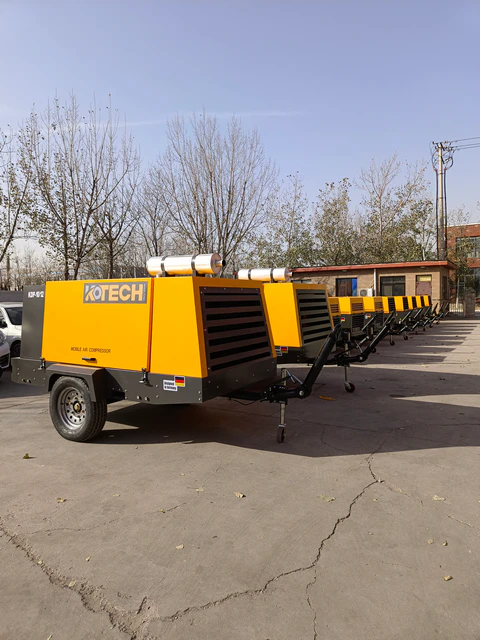
Mastering Mining Air Compressor CFM
Key Insights:
- CFM isn’t just about tool requirements; it’s about holistic system efficiency and future scalability.
- Oversizing leads to significant energy waste, while undersizing causes costly downtime and premature equipment wear.
- Always factor in altitude, ambient temperature, and potential system leaks for accurate demand.
- Operational expenses (OPEX) for energy often dwarf initial capital expenditure (CAPEX) over a compressor’s lifespan.
Getting the CFM right for your mining air compressor isn’t just about matching tool specs; it’s the bedrock of operational efficiency and cost control. Too little, and you face downtime; too much, and you’re burning cash on wasted energy.
Why CFM Matters: Beyond Just Powering Tools
In mining, compressed air isn’t a luxury; it’s the lifeblood for everything from pneumatic drills and rock breakers to ventilation systems and material handling. Cubic Feet per Minute (CFM) defines the volume of air your compressor can deliver. An accurately sized industrial air compressor ensures consistent pressure, prevents equipment strain, and minimizes energy consumption.
Think about it this way: if your compressor can’t keep up with demand, your tools will lag, productivity drops, and eventually, equipment fails. Conversely, if it’s too large, it cycles unnecessarily, wastes power, and generates excess heat, all while incurring higher upfront costs.
The Core Calculation: How to Get Started
Calculating the right CFM begins with a clear understanding of your air demand. Forget the guesswork. You need a systematic approach.
1. List All Air-Powered Tools and Equipment
Start by inventorying every single piece of equipment that will use compressed air. This includes rock drills, jackhammers, impact wrenches, blast hole drills, ventilation equipment, and even air-powered pumps for dewatering. For each item, note its required CFM and operating pressure (PSI). You’ll typically find this information in the manufacturer’s specifications. Don’t overlook smaller, seemingly insignificant tools; their cumulative demand adds up.
2. Determine the Duty Cycle and Simultaneous Use
This is where many operations get it wrong. Rarely are all tools running at their maximum capacity simultaneously. The duty cycle refers to the percentage of time a tool is actively consuming air.
- Continuous Use: Tools running almost constantly (e.g., some ventilation systems, larger drills).
- Intermittent Use: Tools used sporadically (e.g., impact wrenches, small jackhammers).
Estimate the maximum number of tools that will operate concurrently during peak demand. Multiply each tool’s CFM requirement by its estimated duty cycle percentage, then sum these values. This gives you your *effective* air demand.
Factoring in Variables: Don’t Miss the Details
The raw sum of your effective air demand is just the starting point. Real-world conditions in a mining environment introduce critical variables that must be accounted for.
Altitude and Temperature Adjustments
This is a big one, especially for high-altitude mines. Air density decreases with increasing altitude and temperature. A compressor rated for 100 CFM at sea level (standard conditions) will produce less actual air volume at 5,000 feet above sea level or in extreme heat.
You absolutely *must* apply correction factors based on your mine’s specific elevation and average operating temperatures. Ignoring these can lead to a severely undersized system.
System Leaks and Future Expansion
Compressed air systems are notorious for leaks. Even a small hole can waste significant air.
Common Pitfalls and What to Avoid
One of the biggest mistakes is focusing solely on the cheapest initial purchase. A low-cost compressor that’s improperly sized will cost you exponentially more in energy bills and maintenance over its lifespan. Don’t let a poor compressor choice undermine that investment.
Another pitfall is ignoring the receiver tank. While the tank doesn’t generate CFM, it acts as a buffer, storing compressed air for peak demands and allowing the compressor to run more efficiently. An adequately sized receiver tank can help handle intermittent high-demand situations without needing a larger, continuously running compressor.
This calculation primarily applies to stationary, continuous-use systems within a defined operating environment. For highly intermittent or specialized applications like emergency blasting or very short-duration specialized tasks, the approach might shift towards prioritizing receiver tank sizing and rapid recovery rates rather than continuous CFM demand, as the compressor isn’t expected to run constantly.
Real-World Application: A Step-by-Step Guide
Let’s put it all together.
Step 1: Calculate Total Tool CFM Demand
List all tools, their CFM, and estimated duty cycles.
Example:
Subtotal (Effective Demand): 105 + 40 + 180 + 6 = 331 CFM
Step 2: Adjust for Altitude and Temperature
- Adjusted demand: 331 CFM / (1 – 0.15) = 331 / 0.85 = 390 CFM (approx.)
This means your compressor needs to *produce* 390 CFM at its actual operating conditions to deliver 331 CFM effectively.
Step 3: Add Leakage and Future Growth Buffers
- Final CFM Requirement: 390 CFM * 1.25 = 487.5 CFM
So, you’d be looking for a compressor rated for approximately 490-500 CFM under your specific operating conditions.
When to Call a Pro: Expert Consultation
While this guide provides a solid framework, complex mining operations with varied demands, extreme environmental conditions, or plans for significant expansion can benefit immensely from professional consultation. An experienced compressed air system specialist can perform a detailed air audit, analyze your specific site conditions, and recommend the most energy-efficient and reliable mining air compressor solution. They can also help with system design, including piping, air treatment (dryers, filters), and receiver tank sizing, which are all critical components of an efficient system.