Maximizing Efficiency and Reliability in Pneumatic Conveying with Two-Stage Compressors
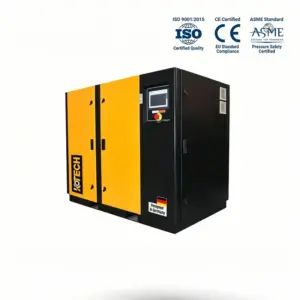
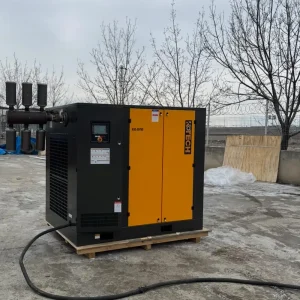
When you’re running a pneumatic conveying system, your compressed air supply isn’t just a utility; it’s the heartbeat of your material handling operation. For the demanding, continuous high-pressure needs of pneumatic conveying, a two-stage compressor is often the smartest, most cost-effective decision you can make long-term.
Why Two-Stage Compressors Dominate Pneumatic Conveying
Pneumatic conveying systems, whether dilute phase or dense phase, require a consistent and often high-pressure air supply to move bulk materials efficiently. This isn’t a job for just any compressor. The continuous duty cycle and specific pressure requirements (often 80-125 psi) place immense strain on a single-stage unit, driving up power consumption and wear.
A two-stage compressor, by its very design, compresses air in two distinct steps. The air is first compressed to an intermediate pressure, cooled, and then compressed again to the final desired pressure. This intercooling significantly reduces the work required for the second stage, leading to a much more efficient process.
The Economics: Energy Savings & Operational Costs
Let’s talk numbers, because that’s where the two-stage advantage really shines.
The initial purchase price of a two-stage unit is usually higher. There’s no getting around that. However, the payback period on that extra investment, purely from energy savings, is often surprisingly short – sometimes as little as 12-24 months for high-usage applications. The Compressed Air and Gas Institute (CAGI) consistently highlights specific power ratings (kW/100 cfm) as the most critical metric for efficiency, and two-stage machines consistently outperform.
Beyond Efficiency: Reliability and System Uptime
Pneumatic conveying systems are often integral to production lines, meaning downtime is a direct hit to profitability. Reliability isn’t a luxury; it’s a necessity.
Two-stage compressors are inherently more robust. By splitting the compression work, each stage operates under less stress and at lower discharge temperatures (typically 50-70°F cooler than single-stage units). This reduced thermal stress significantly extends the lifespan of critical components like bearings, rotors, and seals. Cooler operation also means less moisture in the compressed air, which is vital for protecting downstream equipment, preventing clogs, and ensuring consistent material flow in conveying lines. This also translates to less wear and tear on the conveying system itself, reducing maintenance needs for pipes, elbows, and valves.
When a Single-Stage Might Still Make Sense
If your pneumatic conveying system operates intermittently, for very short bursts, or at extremely low pressures (e.g., below 60 psi) where the efficiency gains of a two-stage unit wouldn’t amortize its higher upfront cost, a single-stage might suffice. Similarly, for applications with very low CFM requirements, the incremental cost of a two-stage might not be justifiable. However, for continuous, high-volume, or high-pressure material transfer, these exceptions rarely apply.
Implementing a Two-Stage System: Practical Considerations
Choosing the right two-stage compressor for your pneumatic conveying system involves more than just horsepower.
Sizing and Flow Requirements
Accurate assessment of your peak and average air demand (CFM) and required pressure (PSI) is non-negotiable. Undersized compressors run constantly and inefficiently; oversized ones cycle excessively, leading to wear and wasted energy. Work with a reputable vendor to conduct a thorough air audit.
Variable Frequency Drives (VFDs)
VFDs adjust the motor speed to match air demand, saving significant energy when your system isn’t running at full capacity. Given that conveying demands often fluctuate, a VFD can optimize efficiency dramatically.
Air Treatment and Quality
The quality of air is crucial for conveying. Ensure your system includes appropriate filtration (particulate and coalescing filters) and dryers (refrigerated or desiccant) to remove contaminants and moisture. This protects both the compressor and your conveying system, extending the life of components and preventing material contamination or clumping.
Air Receiver Sizing
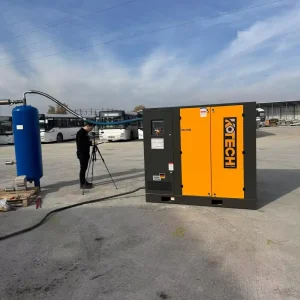
A properly sized air receiver (storage tank) acts as a buffer, preventing rapid cycling of the compressor and ensuring a steady air supply during peak demands. This is especially important for dense phase conveying, which can have intermittent, high-volume air requirements.
The Future of Air Compression in Material Handling
The industry is moving towards smarter, more integrated systems. We’re seeing more IoT-enabled compressors that offer predictive maintenance capabilities, remote monitoring, and energy optimization through advanced algorithms. These innovations promise even greater uptime and lower operational costs.
Ultimately, investing in a properly specified two-stage compressor is an investment in the long-term efficiency, reliability, and profitability of your pneumatic conveying operation. It’s about more than just moving product; it’s about moving it smarter.