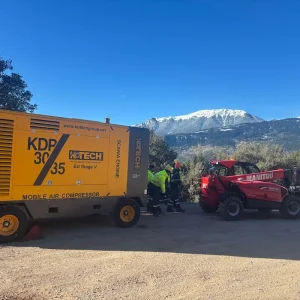

Navigating the complexities of off-grid mining drilling demands robust, reliable, and efficient portable diesel air compressors. This guide, from a seasoned industry expert, cuts through the noise to deliver actionable insights on selecting, operating, and maintaining these critical machines for maximum uptime and cost-effectiveness in the most challenging remote environments.
Mastering Off-Grid Drilling with Portable Diesel Air Compressors
Key Takeaways
- Reliability is paramount for off-grid drilling compressors; failure means significant financial losses.
- Modern diesel compressors with Tier 4 Final engines deliver critical fuel efficiency and power density.
- Remote monitoring (telematics) is a game-changer for predictive maintenance and operational oversight.
- Select compressors based on precise CFM/PSI needs, engine quality, chassis durability, and serviceability.
- While diesel dominates, hybrid solutions exist but often lack the simplicity and independence required for initial off-grid exploration.
Related: Mobile air compressors for exploration · heavy-duty diesel compressors for blast hole drilling · remote mining air power · reliable drilling compressors · mine site compressed air solutions
Operating an off-grid mining drilling site presents unique challenges that few other industries truly understand. You’re not just moving dirt; you’re battling logistics, extreme environments, and the clock. In this demanding landscape, your choice of portable diesel air compressors isn’t just a purchase; it’s a strategic investment in uptime and profitability. Frankly, getting this wrong can derail an entire operation.
- Reliability is Non-Negotiable: Off-grid means no quick fixes. Your compressor must perform consistently under extreme conditions.
- Fuel Efficiency Drives ROI: High fuel costs and difficult logistics make efficient diesel engines paramount for operational savings.
- Portability & Durability: Equipment needs to be easily transportable and tough enough to withstand harsh remote environments.
- Simplified Maintenance: Easy access for routine checks and repairs minimizes downtime, especially when spare parts are scarce.
- Scalability Matters: Ensure your chosen compressor can meet varying air demands for different drilling applications without over- or under-powering.
The Unforgiving Reality of Off-Grid Mining Operations
Off-grid mining drilling isn’t for the faint of heart. We’re talking about sites often hundreds of miles from the nearest paved road, powered by generators, and serviced by dedicated, often expensive, logistics chains. The primary pain points for any mine operator out there usually boil down to three things: uptime, operational costs, and safety. A single equipment failure can halt an entire drilling program, leading to massive financial losses.
Consider the capital expenditure alone: securing a drilling rig, support vehicles, and a crew represents a significant upfront commitment. Add to that the ongoing operational expenses like fuel, labor, and maintenance in remote areas, and you quickly realize why every component needs to pull its weight. This environment doesn’t forgive compromises on equipment quality or performance.
Why Portable Diesel Compressors Remain Indispensable
Despite the growing conversation around electrification, portable diesel air compressors remain the backbone for most off-grid mining drilling applications. Their power density, self-contained nature, and robust performance in extreme temperatures are simply unmatched for remote operations. They deliver the high CFM (cubic feet per minute) and PSI (pounds per square inch) required for blast hole drilling, exploration drilling, and various pneumatic tools without needing a grid connection.
The global mining equipment market, driven by increasing mineral exploration and production, is projected to grow at a Compound Annual Growth Rate (CAGR) of 6.2% from 2023 to 2030, according to a Grand View Research report (2023). This growth underscores continued investment in heavy machinery, including robust air compressors, to support expanding mining activities worldwide. Operators are seeking not just power, but reliability.
S&P Global Market Intelligence (2023) further reported that global nonferrous exploration budgets reached a 10-year high of $13.5 billion in 2023, signaling a surge in remote site development. This directly translates to increased demand for portable, durable equipment capable of supporting these nascent operations. The need for flexible, self-sufficient power sources like diesel compressors is more critical than ever.
Navigating Efficiency: Fuel, Maintenance, and Logistics
Fuel consumption is often the single largest operational cost for remote drilling. Diesel prices, as tracked by the U.S. Energy Information Administration (EIA 2024), can be highly volatile, making every gallon count. Modern portable diesel air compressors, especially those with Tier 4 Final compliant engines, offer significantly improved fuel efficiency compared to older models. Look for features like automatic engine speed control (throttle control) that adjust RPMs based on air demand, rather than running at full throttle constantly. This alone can shave significant percentages off your fuel bill over a drilling season.
Maintenance in remote locations is another beast. Downtime isn’t just inconvenient; it’s catastrophic. A McKinsey & Company report (2020) estimated that unplanned downtime costs the global mining industry billions annually, with some operations losing hundreds of thousands of dollars per hour. This is why easy access to service points, extended service intervals, and robust filtration systems are non-negotiable. I’ve seen firsthand how a well-designed machine with fewer proprietary parts can save weeks of waiting for a specialist or a custom component. Prioritize models where routine checks, oil changes, and filter replacements are straightforward, even for a generalist mechanic.
Logistics for parts and consumables are equally challenging. Standardized components across your fleet, if possible, can simplify inventory management. Remote monitoring systems (telematics) are becoming increasingly vital. They allow you to track fuel levels, engine hours, and performance metrics from a central hub, enabling predictive maintenance rather than reactive repairs. This proactive approach can drastically reduce unscheduled downtime.
When Diesel Isn’t the Only Answer: Hybrid Solutions and Limitations
While diesel remains dominant, it’s important to acknowledge its limitations and consider alternative scenarios. Portable diesel air compressors are not always the best fit for every single application. For instance, in an existing, larger mine where grid power is already established or where environmental regulations are extremely stringent regarding carbon emissions, a stationary electric compressor might be more suitable.
However, for true off-grid exploration or initial mine development, the capital cost and complexity of bringing grid power to a remote site often far outweigh the operational costs of diesel. Hybrid diesel-electric compressors are emerging, offering reduced fuel consumption when a small auxiliary power source is available, but they still typically rely on diesel for peak demand or when no other power is present. These hybrid units are generally more complex, heavier, and come with a higher upfront cost, making them less ideal for the rapid deployment and rugged simplicity often required in early-stage off-grid drilling projects. They simply don’t offer the same plug-and-play independence that a well-built diesel unit provides.
Selecting the Right Unit: A Practical Checklist
Choosing the right portable diesel air compressor requires a meticulous approach. Here’s what my experience tells me you need to consider:
1. Air Output (CFM & PSI):
Match the compressor’s output to your drilling rig’s requirements. Over-specifying means wasted fuel; under-specifying means inefficient drilling. Consult your drill manufacturer’s specifications. A common range for blast hole drilling might be 750-1600 CFM at 350-500 PSI.
2. Engine Type & Emissions:
Look for Tier 4 Final compliant diesel engines. These are more fuel-efficient and meet current emission standards, which is increasingly important even in remote areas as environmental regulations tighten globally. Brands like Cummins, Caterpillar, and John Deere are industry standards for reliability.
3. Durability & Chassis:
The frame, axles, and enclosure must withstand constant vibration, rough terrain, and harsh weather. A heavy-duty, corrosion-resistant chassis and robust trailer package are essential. Think about ground clearance for navigating unpaved roads.
4. Fuel Capacity & Efficiency:
A larger fuel tank means fewer refueling stops, critical for remote sites. Couple this with a fuel-efficient engine to maximize operational hours between refills.
5. Serviceability:
Easy access to filters, fluid checks, and major components saves valuable time. Simple, clear controls are also a plus for operators working long shifts.
6. Filtration & Aftercooling:
Mining environments are dusty. Superior air filtration prevents engine and compressor damage. An effective aftercooler ensures dry, cool air for pneumatic tools, extending their lifespan and preventing moisture-related issues.
7. Telematics & Remote Monitoring:
While an added cost, the ability to remotely monitor performance and anticipate maintenance needs can pay for itself many times over in reduced downtime.
This isn’t just about buying a machine; it’s about securing a critical link in your operational chain. Make an informed decision, and your portable diesel air compressor will be a workhorse, not a headache.
Expert Insights
"In my twelve years working with heavy equipment in remote mining, I've seen countless operations succeed or fail based on the reliability of their air power. A well-chosen portable diesel air compressor isn't just another piece of kit; it's the heart of your drilling program. Investing in quality, understanding your machine's limitations, and committing to proactive maintenance will always pay dividends in the unforgiving landscape of off
— grid mining."
Further Reading
- Dust-Resistant Mining Air Compressors for Open-Pit Environments
- Latest Insights on Mining Air Compressor Performance & Safety
- Mobile Diesel Air Compressors for Mining & Heavy Industrial Tasks
- Compact Air Compressors for Remote Oil & Gas Exploration Sites
- Portable Diesel Air Compressors, Off-Grid Mining, Drilling Equipment, Remote Mine Site, Diesel Air Compressor – Variable-Speed Min
- Industrial Two-Stage Compressor Uses for High-Pressure Air Tools
- Portable Diesel Air Compressors with Low Fuel Consumption for Mines
- Continuous-Duty Mining Air Compressors for 24/7 Production Cycles
About the Author

Related Reading: Air Compressors for Mining: Reliable Power for Critical Tasks